
Workforce Management
Planning-First Workforce Management for Modern Retail Operations
One forecast. One labor plan. One connected workforce system. From labor planning to scheduling and time management, Logile helps retailers turn better plans into better workforce outcomes.
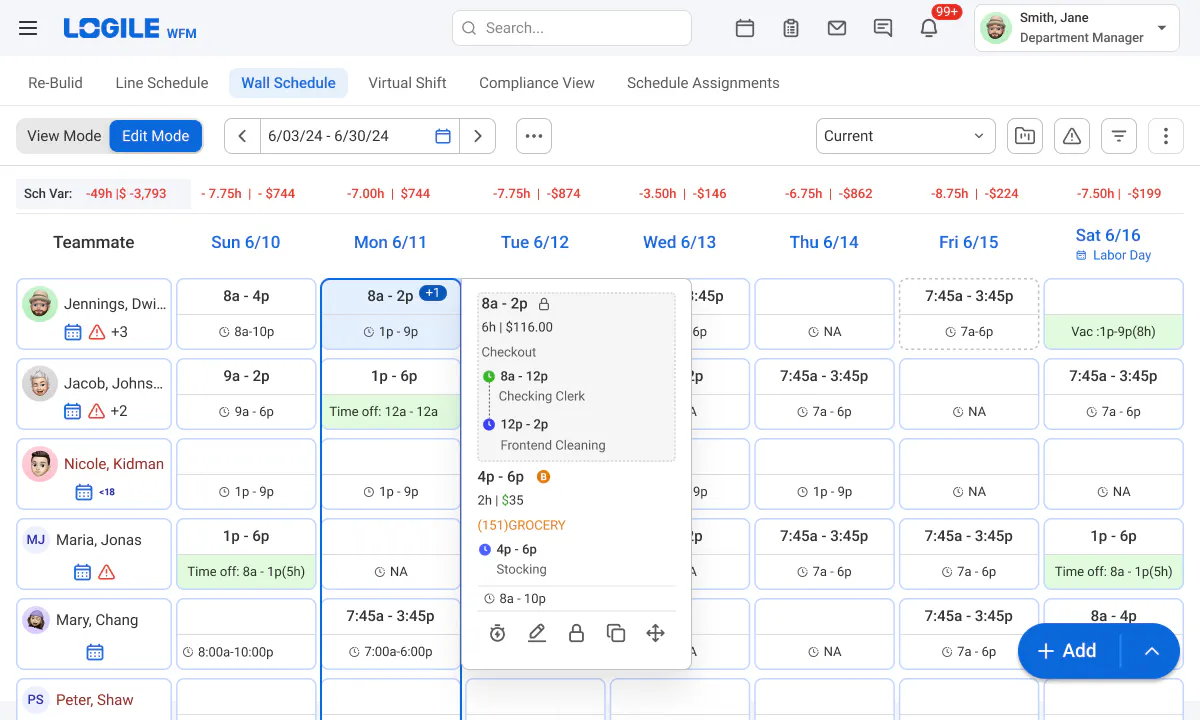

















Why Workforce Management Feels Like Constant Rework
Workforce management breaks when schedules are expected to fix problems that start earlier in the planning process. The result:
Labor hours that do not reflect true workload
Schedules that require constant manager rework
Operational changes that are not simulated before rollout
Compliance risk that surfaces too late
Limited visibility into planned versus actual labor performance
Three Principles that Power Connected Workforce Execution
Instead of starting with schedules, Logile starts with demand, work content, and execution reality.
Forecast-Driven Workforce Demand
Schedule to how customers actually shop
Logile forecasts the true drivers of store workload, including sales, traffic, transactions, units, cases, and department-level demand. Every labor decision starts with a more accurate view of demand.
Outcomes
- More accurate labor demand
- Fewer reactive schedule changes
- Improved labor productivity and service coverage
Bottom-Up Labor Planning
Build labor plans from operational reality
Logile connects labor standards, labor modeling, staff planning, budgeting, and EPS into one planning framework. Retailers can model workforce decisions before they reach stores.
Outcomes
- Executable labor plans
- Better budget-to-workload alignment
- Enterprise-scale planning with store-level precision
Optimized Scheduling & Time
Turn labor plans into schedules that stick
Logile creates compliant, task-aware schedules from staffing requirements. Real-time visibility into worked labor, exceptions, and performance helps teams adapt and continuously improve execution.
Outcomes
- More stable schedules
- Reduced overtime and payroll exceptions
- Stronger compliance confidence and store performance
Two Integrated Solutions, One System
These solution areas work together as one connected workforce management system.
Unified Labor Planning
Plan labor from real demand, real work, and real operating conditions.
What Planning-First Workforce Management Delivers
Retailers using Logile Workforce Management consistently achieve:
~ 6%
Payroll savings
30-50%
Reduction in time spent on forecasting and scheduling
25-35%
Reduction in unplanned overtime
100%
Compliance with labor and predictive scheduling regulations
Analyst-Validated Impact
Nucleus Research found that Logile helps retailers connect workforce planning, scheduling, and store execution into one operating model.
~ 50%
reduction in time managers managing schedules
210 basis points
Improvement in customer satisfaction scores
>1%
Reduction in associate turnover and improved retention
After deploying Logile's Workforce Management platform, retailers:
- Reduced manager scheduling time by an average of 47%
- Improved customer satisfaction by more than 210 basis points
- Reduced associate turnover by more than 1 percentage point
- Increased workforce retention and schedule compliance
Logile's planning-first approach enabled retailers to connect labor planning, scheduling, and execution in a single system, helping stores operate with greater productivity and consistency.
Independent analysis by Nucleus Research validated measurable improvements in scheduling efficiency, customer satisfaction, and workforce retention.
Customer Voices
"Store leaders can spend less time managing schedules and more time driving sales."
Ryan Speakes
VP of C-Stores and Retail WFM, SpartanNash
"Logile's complete workforce management solution supports our store managers by handling the complexity of labor planning and scheduling."
Kim Anderson
VP of Store Operations, Schnucks
"Everything is in one place instead of 12 separate Excel models. Logile’s labor model configured store- and department-specific staffing rules across approximately 180 labor tasks and a 15-minute level staffing demand, which is fantastic for efficient labor planning and scheduling."
Jos Howell
Store Resource Manager, M&S
"We spoke with 19 different vendors and it was always Logile for me. Logile have never over-sold their product and it’s delivered everything they’ve said it would."
Chris Thompson
Labour Resource Planning Manager, Booths
Retail Workforce Management FAQs
Retail workforce management software helps retailers connect workforce planning, scheduling, time and attendance, compliance and store execution. Retail-specific systems account for fluctuating customer demand, store-level workload, operating requirements and associate availability so labor decisions can better reflect what each location needs.
Employee scheduling focuses on assigning associates to shifts. Retail workforce management covers the broader process that informs those schedules, including forecasting demand, determining labor requirements, planning staffing levels, managing labor budgets, tracking time and attendance, and measuring execution. Scheduling is one part of the larger workforce management process.
A schedule can only be as effective as the assumptions behind it. Retailers first need to understand expected demand, required work, available workforce capacity and labor constraints. Establishing those requirements before assigning shifts helps stores schedule against operational needs rather than correcting labor mismatches after schedules are already built.
Retailers can connect labor budgets to store workload by using demand forecasts and labor standards to determine the work each location is expected to perform. Those requirements can then inform labor plans and budgets at the store and department level, helping retailers evaluate labor investment against expected operational needs rather than relying primarily on historical spending.
Workforce management can help retailers compare actual conditions with the original forecast and labor plan as the week unfolds. Updated demand signals, attendance information and operational performance can give managers greater visibility into where coverage may need to change, helping them respond to emerging gaps without abandoning the broader labor plan.
Retail locations can have different demand patterns, operating hours, department mixes, service models and workforce constraints even within the same chain. Store-level workforce planning helps retailers account for those differences rather than applying the same labor assumptions everywhere, creating plans and schedules that more closely reflect how individual locations operate.