
Labor Planning
From Static Labor Planning to Continuous Workforce Optimization
Most labor planning solutions stop at forecasting demand and calculating staffing needs. Logile starts earlier, connecting demand forecasting, labor standards, staff planning, budgeting, and simulation into one continuous planning platform, giving retailers the precision to plan labor at the operational level and the confidence to evaluate decisions before execution.
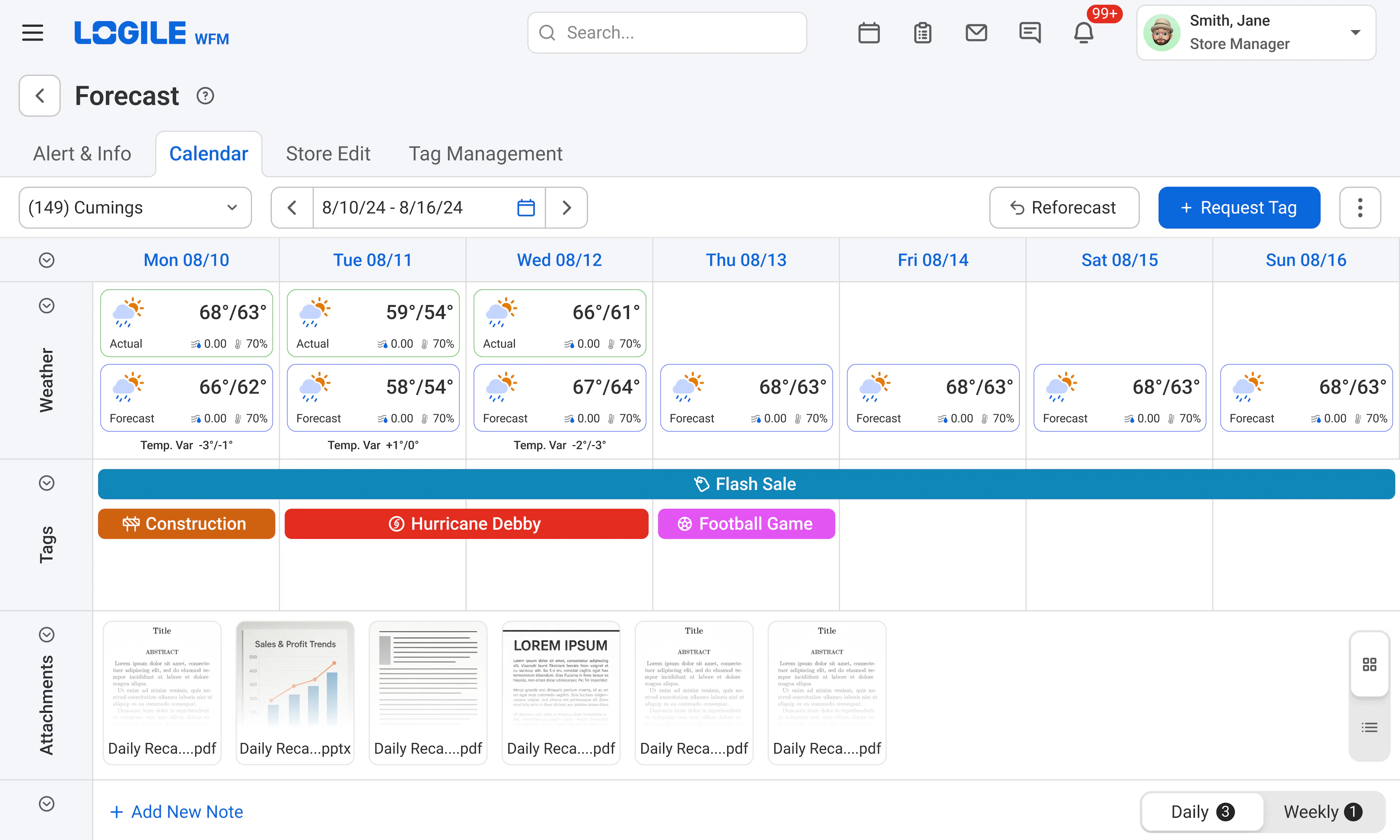

















Why Traditional Labor Planning Can't Keep Up
Labor planning breaks when outdated annual budgets, static labor standards, and disconnected spreadsheets are expected to keep pace with today's retail environment.
Labor plans built on outdated assumptions
Budgets disconnected from operational reality
Workforce decisions made without understanding downstream impact
Scenario planning managed in spreadsheets instead of the planning platform
Limited visibility into workforce investments across the enterprise
Three Principles That Power Continuous Workforce Optimization
Instead of treating labor planning as a periodic budgeting exercise, Logile continuously connects demand, labor, finance, and workforce strategy.
Forecast-Driven Workforce Demand
Plan labor around how customers actually shop.
Logile forecasts the true drivers of workload, including sales, traffic, transactions, units, cases, fulfillment demand, and department-level operational activity. Every labor decision starts with one AI-driven demand signal.
Outcomes
- More accurate labor demand
- Better labor productivity
- Improved service coverage across every store
Bottom-Up Labor Planning
Build labor plans from operational reality
Logile connects Enterprise Labor Modeling, Staff Planning, Budgeting, and the Enterprise Productivity Simulator (EPS) into one planning framework. Retailers can model workforce decisions before they reach stores.
Outcomes
- Executable labor plans
- Better budget-to-workload alignment
- Enterprise-scale planning with store-level precision
Continuous Workforce Optimization
Keep workforce plans aligned as business conditions change.
As demand, labor availability, or operational priorities change, retailers can continuously reforecast, evaluate workforce impacts, model scenarios, and optimize labor investments before execution.
Outcomes
- Faster planning cycles and greater agility
- Better workforce utilization
- Alignment amongst Operations, HR, and Finance
Two Integrated Solutions, One System
These solution areas work together as one connected workforce management system.
Unified Labor Planning
Plan labor from real demand, real work, and real operating conditions.
What Continuous Labor Planning Delivers
Retailers using Logile Labor Planning consistently achieve:
Up to 97%
Daily forecast accuracy across sales and workload demand
30-50%
Reduction in time spent on forecasting and scheduling
~6%
Reduction in labor costs
25–35%
Reduction in unplanned overtime
Analyst-Validated Impact
Nucleus Research found that Logile helps retailers connect workforce planning, scheduling, and store execution into one operating model.
~ 50%
reduction in time managers managing schedules
210 basis points
Improvement in customer satisfaction scores
>1%
Reduction in associate turnover and improved retention
After deploying Logile's Labor Planning, retailers:
- Reduced manager scheduling time by an average of 47%
- Improved customer satisfaction by more than 210 basis points
- Reduced associate turnover by more than 1 percentage point
- Increased workforce retention and schedule compliance
Logile's planning-first approach enabled retailers to connect labor planning, scheduling, and execution in a single system, helping stores operate with greater productivity and consistency.
Independent analysis by Nucleus Research validated measurable improvements in workforce planning efficiency, financial alignment, and operational execution.
Customer Voices
"Everything is in one place instead of 12 separate Excel models. Logile’s labor model configured store- and department-specific staffing rules across approximately 180 labor tasks and a 15-minute level staffing demand, which is fantastic for efficient labor planning and scheduling."
Jos Howell
Store Resource Manager, M&S
"We spoke with 19 different vendors and it was always Logile for me. Logile have never over-sold their product and it’s delivered everything they’ve said it would."
Chris Thompson
Labour Resource Planning Manager, Booths
"Logile's AI and machine learning forecasting algorithms adapted to produce accurate sales and item level forecasts across all our stores."
Scott Russo
Director of Workforce Management, Schnucks
FAQs
Retail labor planning is the process of translating forecasted customer demand, operational workload, labor standards and financial targets into staffing requirements and executable labor plans. It helps retailers determine how much labor each store and department needs, when that labor is needed and how workforce investments should support service, productivity and profitability.
Retail labor planning software connects demand forecasting, labor modeling, staff planning, budgeting and scenario analysis in one system. It helps retailers replace static spreadsheets and disconnected annual planning processes with continuously updated labor plans based on store-level demand, workload and operating conditions.
Labor forecasting estimates future workload and labor demand based on expected sales, traffic, transactions, units, fulfillment activity and other operational drivers. Labor planning uses that forecast, together with labor standards, budgets, staffing capacity and business priorities, to determine the workforce resources needed to operate each store effectively.
Labor planning determines how much labor the business needs and where workforce resources should be invested. Employee scheduling assigns available associates to specific shifts, roles and tasks. Accurate schedules depend on an effective labor plan that reflects customer demand, store workload, employee availability and financial targets.
AI improves retail labor planning by identifying demand patterns, continuously updating forecasts and evaluating more variables than manual planning processes can manage. AI-powered forecasting can account for sales, traffic, promotions, weather, seasonality, fulfillment demand and local events, helping retailers build more precise labor plans and respond faster when conditions change.
Accurate retail labor planning uses sales and traffic forecasts, transaction and item volumes, operational workload, labor standards, store and department characteristics, employee availability, wage rates, budget targets and historical performance. Connecting these inputs creates labor plans grounded in the work stores actually need to perform.
Retailers should begin seasonal labor planning before schedules are created. They should forecast demand at the store and department level, model workload changes, evaluate existing staffing capacity, identify hiring and skill gaps, test budget scenarios and build contingency plans. Continuous reforecasting helps labor plans stay aligned as promotions, fulfillment demand and customer behavior change.
Labor planning reduces costs by matching workforce resources more precisely to customer demand and operational workload. Better alignment can reduce unnecessary hours, overtime and reactive scheduling while protecting service coverage during high-demand periods. The goal is not simply to use fewer hours. It is to invest labor where it produces the greatest operational and customer impact.