
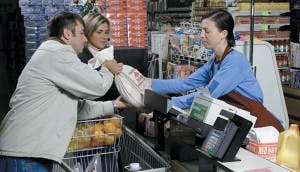
Ask managers in most retail organization the percentage of their transactions that involve only 10 items or less. Never mind that their so-called “express registers” – if they still staff them – sport signs declaring 12, 15, 20 or more items to be eligible for this service. Just see what they guess.
You will find that many of those managers will be started to learn that 10 items or less will likely qualify 60% or more of their customer transactions, often double the number that they estimate. Is that so surprising as we serve customers with an increasing desire for fresh perishables and convenient home meal dinner solutions? Or, as we build stores to deliver greater deli and quick food options than ever before for breakfast, lunch and dinner? Not really, but it still comes as a surprise to many managers who tend to focus more on the larger baskets.
So what are the implications for providing real express service to your customers?
Here are a few takeaways you might want to think about:
- Self-checkout is a different type of service experience for customers, distinct from express checkout. Some customers embrace it, others don’t. But don’t mistake it for express checkout service. If you have service registers, ask yourself if some of them still ought to be express designated.
- Express checkout service doesn’t change the workload of your Front End. It fast-tracks a certain segment of your transactions (based on order size) so that customer perceptions of wait times improve. Why does the perception change? People tend to perceive their wait for service based on the number of people ahead of them rather than the number of items ahead of them. When you fast-track the small orders you expedite the number of people waiting to be served. Fewer people make for less anxious waits in line.
- There also seems to be a strong correlation between small order size and customer needs for a quick checkout experience. Limited time over lunch, quick stop on the way to work, quick stop on the way home, all have express urgency in the customer’s mind. If you aren’t prepared to deliver that quick service, then those shopping trips will likely go to other formats.
- If a huge percent of your transactions qualify for your “express service” how “express” can it be? Consider whether you can improve perceptions for more people by lowering that limit to 10, to 8, or to whatever your customer service needs call for. Find the right balance that avoids excess idle time but expedites those small orders and enhances your service perceptions for all customers.
If you are working to provide express customer service, just make sure it really is express to build lasting customer satisfaction. Then work your game plan through effective labor standards, modeling, forecasting and scheduling to help your associates execute consistently.
Recent Posts
Holiday Is the Ultimate Test of Your Labor Plan
2026-10-05
Holiday puts every labor planning assumption to the test. See how retailers can model demand, staffing, service, and cost scenarios before stores have to.
Read More
Fresh Operations Industry Survey
2026-10-01
Logile’s survey of 200 retail leaders reveals fresh operations challenges across visibility, shrink, labor planning, AI and technology.
Read More
Back-to-School Is Ending: The Q4 Retail Rush Is Already Here
2026-09-01
Back-to-school is ending, but Q4 retail demand is already building. Learn how retailers can prepare labor plans for holiday traffic, promotions and fulfillment.
Read More