
Retailers have invested decades refining how labor is forecasted, budgeted, scheduled, and managed. Yet despite advances in workforce management technology, labor remains one of the most difficult areas of the business to optimize given the many interconnected factors that affect it:
- Store productivity varies widely across locations.
- Service levels are inconsistent.
- Labor costs continue to rise.
- New operational initiatives often create unintended consequences.
And despite more data than ever before, workforce decisions are still frequently made with limited visibility into how they will actually perform once they reach stores. Rather than a lack of planning, the fundamental challenge is that most planning systems were never designed to answer the questions retailers face today.
The Scale Versus Precision Problem
For years, labor planning has operated within an uncomfortable constraint. Retailers could plan at enterprise scale, or they could understand operations with precision. Rarely both.
Enterprise planning tools helped organizations build budgets, allocate labor investment, establish productivity targets, and align workforce strategies across hundreds or thousands of stores. These capabilities remain essential, particularly for large retailers managing complex operations across multiple regions, formats, and departments.
But enterprise planning often comes at the cost of operational detail. A decision that appears sound when viewed through enterprise averages can look very different inside an individual store.
Consider something as common as extending operating hours. At a high level, the decision may appear financially attractive. Additional sales justify additional labor. The business case works. What that analysis often misses is how the decision affects individual stores, where the operational consequences can be significant.
· A suburban store with stable staffing may absorb the change easily.
· An urban location already struggling with labor availability may require overtime.
· A fresh department may need additional preparation hours.
· A fulfillment-heavy location may experience entirely different workload patterns.
The enterprise view is necessary, but the store-level reality is equally important. And historically, retailers have had to choose which perspective mattered more.
Why Traditional Scenario Planning Falls Short
Most retailers already perform some form of scenario planning. During annual budgeting cycles, leadership teams evaluate wage increases, productivity initiatives, operating model changes, and labor investment decisions. Finance teams build assumptions, operations teams provide feedback, and HR contributes workforce considerations. The process is valuable, but it is often limited by the tools available.
Many scenarios are still evaluated using spreadsheets, static assumptions, or aggregated labor models. These approaches can estimate broad financial impacts but struggle to capture operational consequences with meaningful precision.
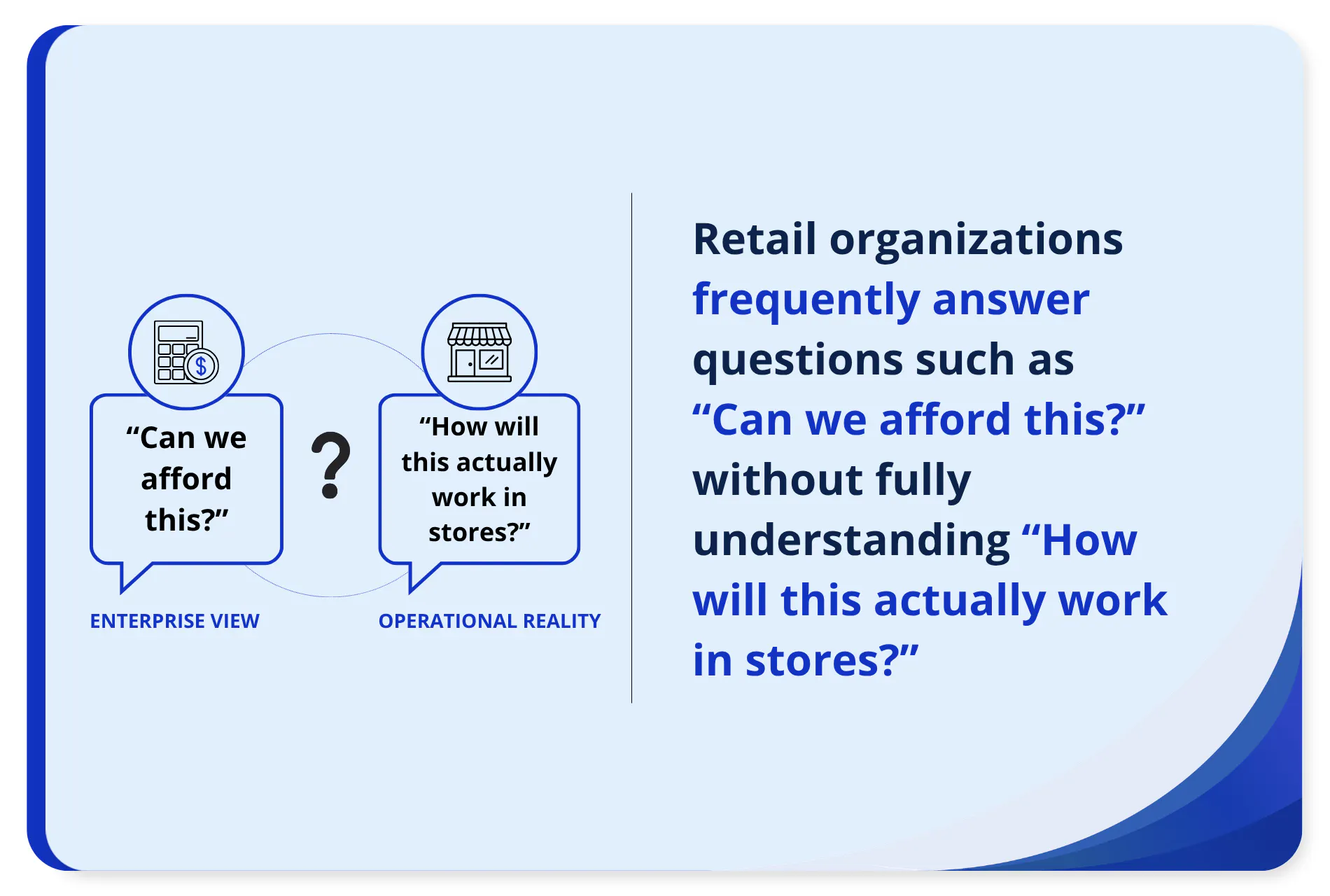
As a result, organizations frequently answer questions such as "Can we afford this?" without fully understanding "How will this actually work in stores?"
That distinction becomes increasingly important as retail operations become more dynamic. Omnichannel fulfillment, fresh operations, local demand variability, labor availability challenges, and changing customer expectations all create conditions where seemingly small workforce decisions can produce significant downstream effects.
The cost of getting those decisions wrong has never been higher.
The Shift From Labor Management to Workforce Decision-Making
For much of the past two decades, workforce technology has focused on the basic elements of execution: forecasting demand, generating schedules, managing time and attendance, tracking compliance, and automating labor administration. These capabilities remain critical, but they primarily operate after key workforce decisions have already been made.
Long before a schedule is generated, retailers are deciding:
- How much labor to invest
- What service levels to deliver
- Which operational initiatives to fund
- How labor standards should evolve
- Where productivity improvements should come from
- How stores should be staffed
Those decisions shape everything that follows. In fact, many of the productivity challenges retailers experience today originate long before schedules are created.
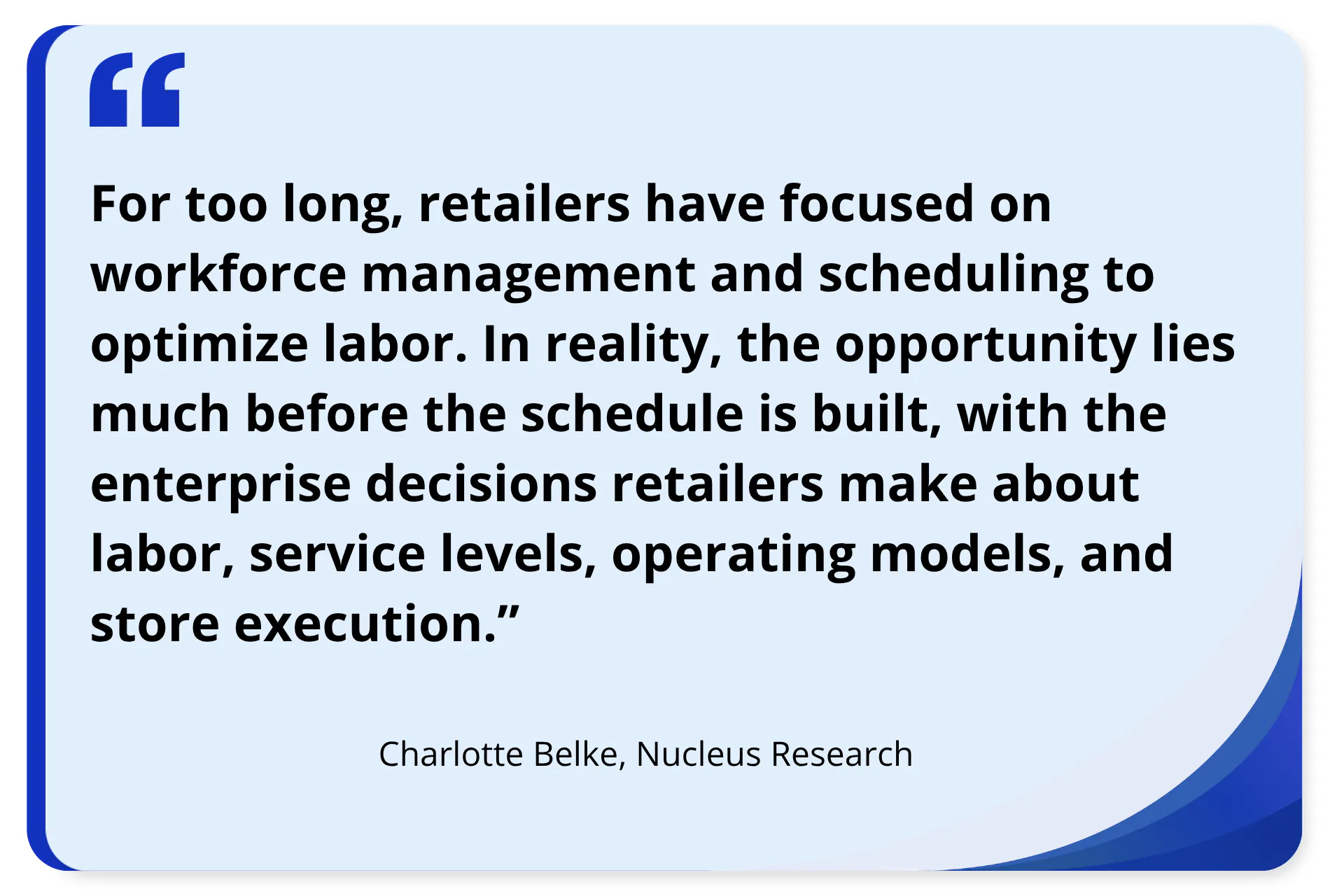
“For too long, retailers have focused on workforce management and scheduling to optimize labor,” said Charlotte Belke, analyst, Nucleus Research. “In reality, the opportunity lies much before the schedule is built, with the enterprise decisions retailers make about labor, service levels, operating models, and store execution.”
This is why the conversation is beginning to shift from labor management toward workforce decision-making. The question is no longer just "How do we manage labor more efficiently?"
The more strategic imperative is increasingly "How do we make better workforce decisions before execution begins?"
Enter Workforce Simulation
This is where workforce simulation becomes meaningful. Not because simulation itself is new. Retailers have modeled scenarios for years. What is changing is the ability to evaluate enterprise decisions while preserving operational reality.
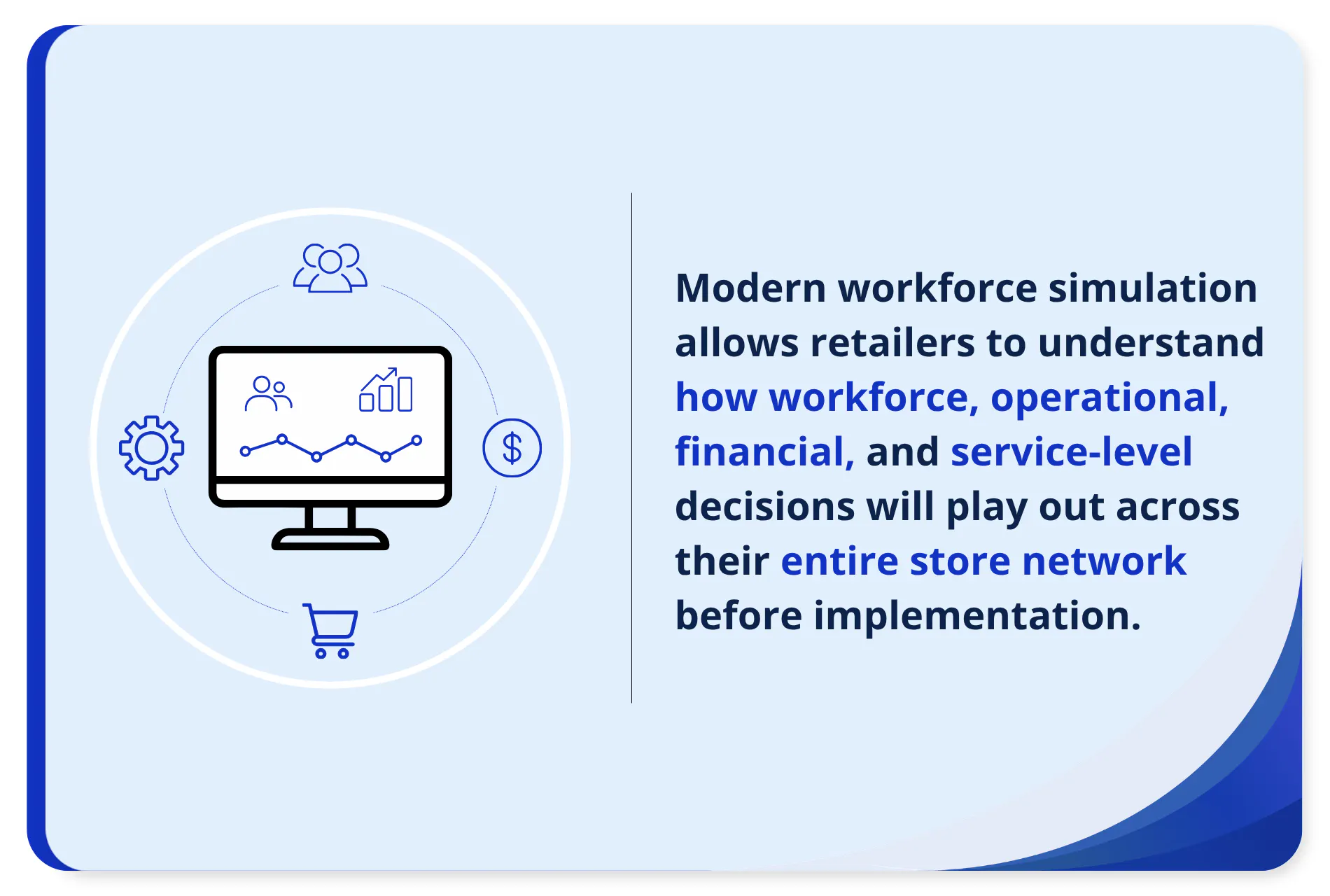
Modern workforce simulation allows retailers to understand how workforce, operational, financial, and service-level decisions will play out across their entire store network before implementation. Rather than relying on averages, organizations can evaluate impacts at the store, department, role, and time-interval level.
That level of visibility changes the nature of planning.
- A retailer considering a new fresh production process can understand how labor requirements shift throughout the day.
- An operations team evaluating service-level changes can see where additional coverage will be needed.
- Finance leaders can compare labor investment scenarios and understand not only the cost implications but also the operational tradeoffs.
Instead of debating assumptions, teams can evaluate outcomes. Instead of reacting after rollout, they can identify risks and opportunities before execution begins. Most importantly, retailers no longer need to choose between enterprise scale and operational precision. They can have both.
Why This Matters for Retail Productivity
The broader significance of workforce simulation extends beyond planning and fundamentally changes how retailers pursue productivity. Historically, productivity initiatives have often been measured after implementation. Organizations launch a program with some simulation, monitor results, and adjust as issues emerge. The problem with this approach is that stores become the testing ground.
Workforce simulation creates an opportunity to evaluate decisions before they impact customers, associates, or financial performance. That changes how organizations approach labor investment, service strategies, staffing models, and operational transformation initiatives. Rather than asking whether a decision succeeded after rollout, retailers can begin evaluating likely outcomes before implementation. This creates a more proactive, disciplined approach to workforce optimization that is grounded in operational reality rather than assumptions.
The Foundation for Continuous Workforce Optimization
Perhaps the most important implication is what workforce simulation enables next. Retail operates in a volatile environment with constantly changing demand, costs, workforce availability, and customer expectations.
Planning can no longer be treated as an annual exercise followed by twelve months of execution. Organizations need the ability to continuously evaluate decisions as conditions change. That requires a connected planning framework where forecasting, labor modeling, staffing, budgeting, simulation, and execution operate from the same foundation.
Workforce simulation becomes the bridge between planning and execution. It allows organizations to test decisions, understand tradeoffs, and continuously refine workforce strategies before changes reach stores. In that sense, workforce simulation is not simply the next phase of labor planning.
It represents an important elevated step toward Continuous Workforce Optimization, where workforce decisions are evaluated, refined, and improved as conditions evolve.
Looking Ahead
Retailers have spent years improving how labor is managed. The next opportunity lies in improving how workforce decisions are made.
As operations become more complex and the cost of workforce decisions continues to rise, organizations need greater confidence that the choices they make at headquarters will succeed in stores.
The ability to connect enterprise planning with store-level reality has long been one of the industry's most difficult challenges. Workforce simulation represents one of the first meaningful attempts to solve it.
And as retailers continue searching for new ways to improve productivity, service, and execution, the ability to test decisions before they reach the floor may become just as important as the ability to schedule labor once they get there.
See Workforce Simulation in Action
Logile addresses these issues to help retailers test workforce, operational, and financial decisions before they reach stores with the recently launched Enterprise Productivity Simulator (EPS).
EPS establishes a new approach to enterprise workforce planning and decision-making. Using AI, operational models and store-specific data, retailers can simulate strategic decisions across thousands of stores simultaneously, understand their financial and operational consequences, compare alternatives, and finalize the optimal enterprise strategy before committing labor investments.
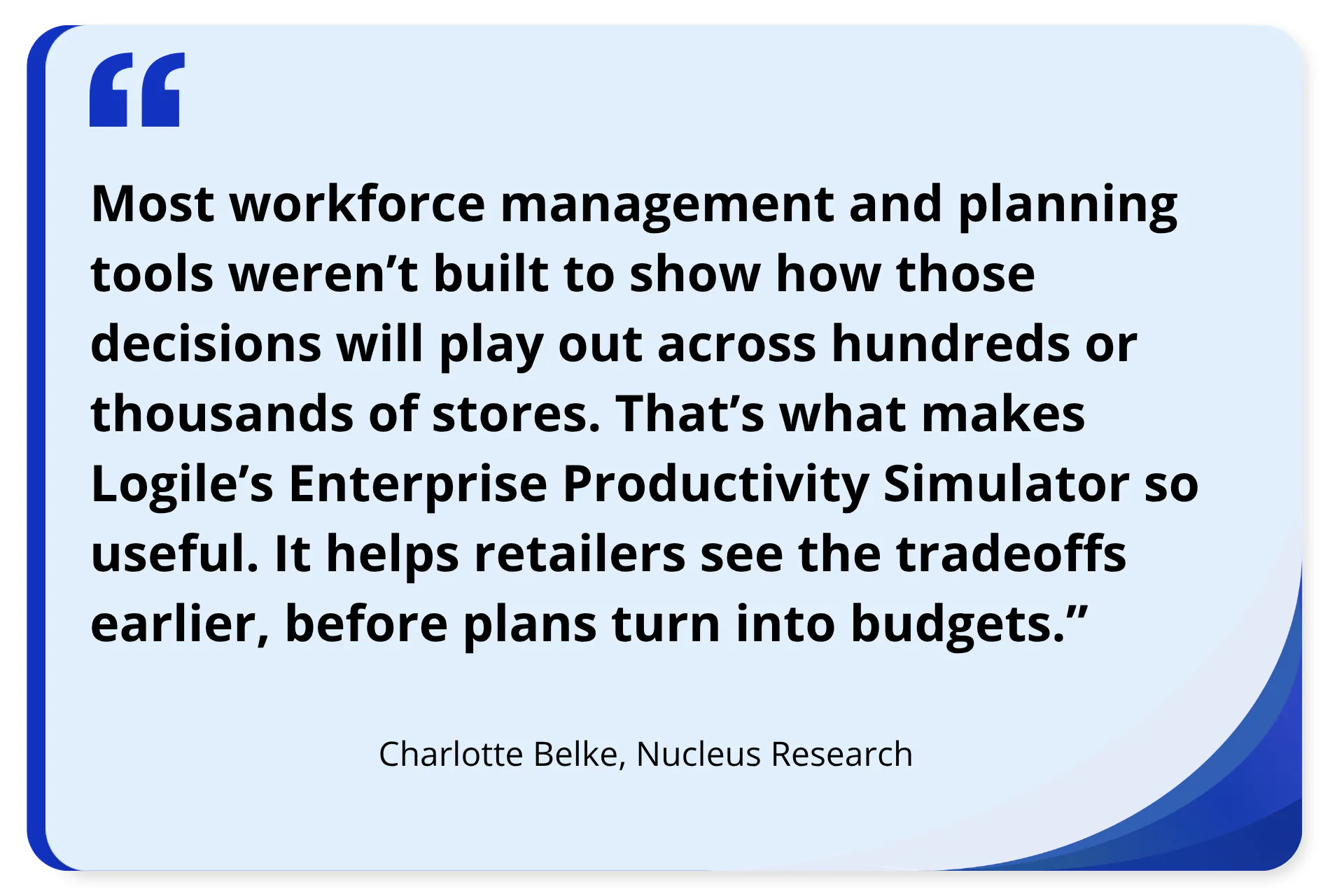
“Most workforce management and planning tools weren’t built to show how those decisions will play out across hundreds or thousands of stores,” said Belke, Nucleus Research. “That’s what makes Logile’s Enterprise Productivity Simulator so useful. It helps retailers see the tradeoffs earlier, before plans turn into budgets.”
Check out Logile EPS at Logile Connect 2026 in Scottsdale Sept 22-24, and join us for three days of product innovation, hands-on learning, and peer connection designed to help retailers run great stores.