
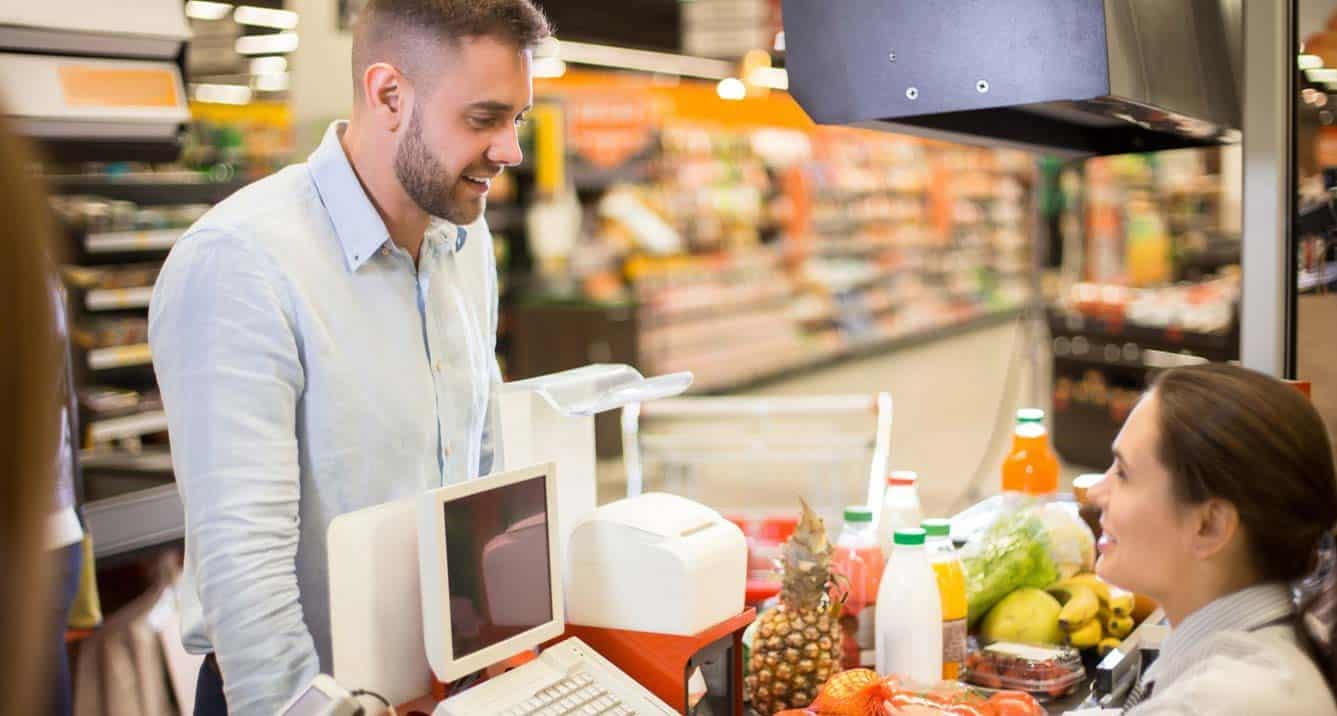
Improving grocery front-end productivity requires retailers to reduce unnecessary checkout delays while maintaining transaction accuracy and customer service. Two important measures are tender time, which tracks payment processing, and items per minute (IPM), which measures scanning productivity.
Retailers can improve checkout efficiency by streamlining loyalty card processes, reviewing manager approval workflows, standardizing cashier scanning methods, making product lookup codes easier to access, and optimizing register layouts.
These improvements should be evaluated alongside customer wait times, transaction accuracy, and employee performance to ensure that faster checkout processes also support a positive shopping experience.
| Improvement Area | Recommended Action | Productivity Benefit |
|---|---|---|
| Loyalty card processing | Request loyalty identification while items are being scanned | Reduces unnecessary waiting during tendering |
| Manager approvals | Review approval workflows and reduce avoidable delays | Limits transaction interruptions |
| Cash verification | Evaluate verification procedures based on risk and policy requirements | Reduces unnecessary handling |
| Scanning methods | Train associates on efficient, ergonomic scanning techniques | Supports consistent items-per-minute performance |
| PLU lookups | Make frequently used produce lookup codes readily accessible | Reduces time spent searching for item codes |
| Register layout | Position equipment and supplies to minimize unnecessary movement | Improves checkout workflow efficiency |
| Performance coaching | Monitor IPM and related service metrics | Identifies training and process improvement opportunities |
Key takeaway: Grocery retailers can improve front-end productivity by reducing unnecessary transaction steps, standardizing checkout processes, and monitoring multiple performance indicators rather than focusing on scanning speed alone.
How Can Grocery Retailers Reduce Checkout Tender Time?
We can begin with tendering. Normally, retailers divide register productivity into item processing, tender time and idle time. These three processes are monitored through POS systems. Tendering refers to the time between a cashier hitting the “Total” key on the register until he closes the till or prints a receipt. Retailers often use the metric average tendering time to determine this time interval, then they attempt to reduce it. The following are a few tips that might aid in this process.
Streamline Loyalty Card Identification
Loyalty cards incentivize loyal customers; shoppers often use these during tendering. Typically, a cashier asks for a loyalty card before scanning and waits for the customer to provide it. Per lean engineering principles, every time an employee waits on a customer, the retailer wastes money. One opportunity to avoid waiting is to internalize this task (i.e., include it within another process). For instance, asking the customer to use her loyalty card while the cashier scans items saves time and money.
Review Payment Authorization Requirements
Payment authorization requirements vary by payment method, card network, transaction type, and retailer policy. Rather than assuming signatures are required for transactions above a particular dollar amount, retailers should review their current payment acceptance procedures with their payment providers.
Checkout process improvements may include reducing unnecessary prompts, ensuring payment terminals are accessible, and helping customers complete required authorization steps efficiently.
Any changes should remain consistent with applicable payment network requirements, security procedures, and company policies.
Reduce Unnecessary Manager Interventions
Managers are often required to consent on transactions involving WIC, high-theft items, special keys or cancellations. When cashiers call for managers, the queue halts, increasing wait times for customers. Similar to customer signature requirements, manager involvement policies are often set for compliance, become store habit and remain unchallenged. An analysis of their need, by transaction type, could reveal savings opportunities.
Review Cash Verification Procedures
Retailers might consider which bill denominations require marking based on company strategy. Counterfeit bills are a reasonable fear for retailers; however, marking too many bills as compared to the risk causes waste. What is the estimated counterfeit percentage by denomination? Maybe the risk warrants the policy for some denominations and locations, but maybe it can be adjusted. After changes are applied, ensure you monitor the policy moving forward.
How Can Grocery Stores Improve Items per Minute?
Now, let us move onto another front end productivity topic. The metric items per minute (IPM) is one the most commonly used KPI’s in front end departments to measure productivity. Higher IPM equates to lower checkout time; the lower the checkout time, the more satisfied the customer will be. There are several recommended ways to increase your IPM.
Standardize Scanning Methods
Encouraging two-handed scanning by cashiers is pivotal. In an ideal scenario, items are processed by grasping with the leading hand, then transferring to the other hand to scan. During scanning, the lead hand returns to grasp a new item. The goal is to always be using two hands. Training employees on this methodology is key.
Make PLU Codes Easier to Access
During item processing, cashiers code weighted items based on their Price Lookup, or PLU. Most cashiers, especially recent hires, will rely on using a database search option or paper reference to find the right PLU. To make this process more rapid, a retailer might implement a visual cue with the top 20 percent of PLU codes. This sheet could then be standardized and used across stores or tailored for stores with specific offerings.
Optimize Checkout Workstation Layout
Changes in register layout often require capital expenditures. Nevertheless, a carefully planned change can have a huge impact on a metric like IPM and yield an attractive ROI. Consider fixture design factors that reduce cashier movement, such as customer unload registers or carrousel bagging workstations. The best register layouts will optimize movement by reducing steps for cashiers to complete tasks.
Use Performance Metrics for Coaching
Accountability is necessary in change management. Only through effective training and monitoring can an improved IPM metric be sustained. Through visual feedback, cashiers can be made aware of their productivity by showing them their IPM. Retailers can even incentivize process improvements like two-handed scanning through compensation. Several considerations in this process are data tracking, management expectations, and cashier abilities.
What Should Retailers Consider When Improving Cashier Productivity?
When implementing programs to improve IPM, side effects may result if not anticipated by leadership. For instance, implementing incentives for increased IPM while neglecting other company values might result in reduced customer service. To combat such an issue, include parallel tracking of KPIs through surveys or mystery shopping. Communicate to employees which values take priority, and make these expectations realistic. By doing this, your program can improve KPIs while not conflicting with others.
How Can Labor Planning Support Front-End Productivity?
Improving checkout processes is only one part of front-end productivity. Grocery retailers must also ensure that the right number of qualified associates are available when customer demand increases.
Retailers can strengthen front-end operations by combining efficient checkout methods with:
- Workload analysis: Understand how transaction volume, item counts, and payment activities affect labor requirements.
- Labor standards: Establish realistic expectations for checkout tasks and supporting activities.
- Demand-based scheduling: Align staffing levels with expected customer traffic and transaction activity.
- Performance monitoring: Track checkout efficiency alongside transaction accuracy and customer service.
Logile's Enterprise Labor Modeling solution helps retailers translate task-level work into labor requirements using engineered labor standards.
These requirements can inform Labor Scheduling, which helps retailers align staffing with operational demand, associate qualifications, and availability.
By connecting checkout process improvements with labor planning, grocery retailers can improve front-end efficiency without treating cashier speed as the only measure of success.
Recent Posts
Shoppers Are Abandoning $113 Shopping Trips When Stores Aren’t Ready for the Rush
2026-11-12
Shoppers abandon trips worth $113 when stores aren’t ready for the rush. See how peak-hour understaffing shapes where they spend.
Read More
When Every Degree Matters: Rethinking Food Safety in Grocery Retail
2026-11-11
Learn how continuous temperature monitoring helps grocers detect refrigeration issues earlier, reduce manual checks and coordinate food safety responses.
Read More
Four Peaks, One Team: What the Rest of the Holiday Season Will Ask of Your Stores
2026-11-06
Plan retail labor for promotions, Cyber Week, gifting and returns. Connect changing holiday demand to staffing, budgets and better 2027 planning.
Read More