


How reactive staffing decisions during holidays and peak hours can put customer experience, associate experience, and labor compliance at risk.
When peak demand exposes more than a staffing gap
The holiday rush puts retail operations to the test. Customer traffic increases, promotions drive sudden surges in demand, fulfillment volumes rise, and store teams are expected to deliver more within increasingly tight labor budgets.
But the consequences of getting staffing wrong extend well beyond a busy checkout line.
Logile's 2026 Peak Hour Penalty Report found that 78% of surveyed shoppers had left a store without making a purchase because of rush-related problems, including long checkout lines and insufficient assistance. The findings highlight a familiar retail challenge: when labor isn't aligned with customer demand, retailers risk losing sales, disappointing shoppers, and weakening customer loyalty over time.
Yet there is another consequence of poor workforce planning that receives far less attention.
When stores are understaffed, managers often have to make last-minute decisions to keep operations running. They extend shifts, call associates in, rearrange breaks, change assignments, and adjust schedules that may already have been published.
These decisions can help protect the customer experience in the moment, but they can also introduce additional labor costs, disrupt associates' schedules and create compliance exposure.
That is the double penalty of peak hours. Poor planning can cost retailers at the checkout and create a second layer of risk in how they manage their workforce.
And while the holiday season makes these pressures more visible, the underlying challenge exists wherever retail demand peaks, from weekends and promotional events to seasonal transitions and everyday rush periods.
When the plan falls short, the pressure moves to the store
Retailers spend considerable time planning labor budgets, forecasting demand and creating schedules. But even a carefully constructed schedule can fall short when it doesn't accurately reflect the workload, staffing requirements, and skills needed at different times of the day.
Consider a store facing an unexpected surge in customer traffic. Checkout lines begin to grow, replenishment falls behind, and associates are pulled from other departments to maintain service.
The store manager has limited options. Additional coverage may be needed immediately, but bringing in employees at short notice, extending shifts, or rearranging breaks can have consequences beyond the labor budget.
Depending on the jurisdiction and circumstances, schedule changes may trigger advance-notice requirements, employee-consent obligations, or predictability pay. Additional hours may introduce overtime exposure, while insufficient staffing can make it harder to provide required meal and rest breaks.
For retailers operating across multiple states and municipalities, those decisions become even more complex. Fair Workweek regulations, working-hour restrictions, collective bargaining agreements and company policies can vary considerably across locations and employee groups.
The challenge is not that store managers are making unreasonable decisions. They are responding to the reality in front of them.
The problem is that a staffing gap can force managers to choose between protecting customer service, supporting associates, and managing compliance risk.
When that happens repeatedly, it is worth looking beyond the schedule to the quality of the workforce plan behind it.
Three experiences, one workforce planning challenge
The impact of reactive staffing decisions is often viewed through separate business functions, even though the underlying problem may be the same.
For customers, insufficient coverage can mean longer waits, limited assistance, delayed replenishment, and inconsistent service. The immediate consequence may be an abandoned purchase, but repeated experiences can also influence where shoppers choose to spend their money.
For associates, the consequences are different but equally important. Last-minute schedule changes, unexpected additional hours, missed or delayed breaks, and repeated requests to cover staffing gaps can make work less predictable and more stressful. Over time, these pressures can affect engagement, satisfaction and retention.
For the business, the same decisions introduce another layer of complexity. Overtime costs can rise, scheduling changes may create additional compensation obligations, and failures to meet applicable labor requirements can result in penalties, disputes and administrative effort.
These are not three independent problems.
They are interconnected consequences of how effectively retailers anticipate demand, plan labor, and manage changes during execution.
A retailer cannot consistently deliver a strong customer experience without supporting the workforce responsible for delivering it. And it cannot sustainably support that workforce without accounting for the labor rules and employee protections that govern how work is scheduled and performed.
Customer experience, associate experience, and labor compliance need to be considered together, not managed as competing priorities.
Why compliance cannot be an afterthought
Retail labor compliance has traditionally been managed through a combination of scheduling controls, timekeeping systems, manager reviews and exception reporting.
These processes remain important. But there is a fundamental difference between identifying a compliance issue after it occurs and reducing the likelihood of that issue arising in the first place.
A schedule may satisfy applicable rules when it is first published, only for subsequent changes to introduce new obligations. Overtime may become visible after additional hours have already been worked. Break exceptions may be identified when timecards are reviewed, even though the underlying coverage problem began much earlier.
The result is a reactive approach in which managers and corporate teams spend considerable time identifying, reviewing, and correcting exceptions.
A more proactive approach begins earlier.
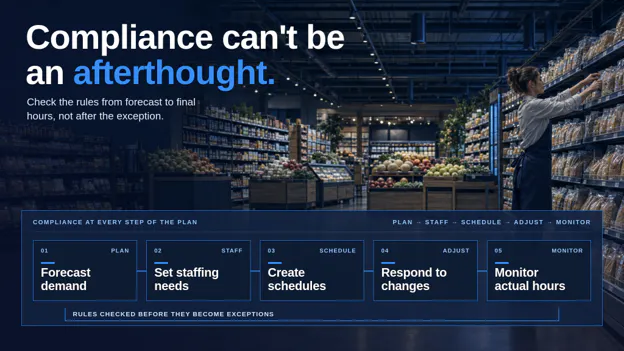
It recognizes that compliance is not simply a final check on a completed schedule. It needs to be considered when retailers forecast demand, determine staffing requirements, create schedules, respond to changes, and monitor actual hours worked.
That shift is especially important during peak periods, when small planning gaps can quickly translate into numerous operational adjustments across stores.
From reactive compliance to proactive workforce planning
Reactive approach
- Address staffing shortages through last-minute schedule changes
- Identify overtime after additional hours have been worked
- Discover break exceptions during timecard review
- Rely on managers to interpret complex scheduling rules
- Review compliance issues after they occur
Proactive approach
- Anticipate demand and plan appropriate coverage earlier
- Consider projected hours and overtime exposure before making adjustments
- Account for break requirements when planning staffing and coverage
- Incorporate applicable requirements into scheduling decisions
- Identify potential risks throughout planning, scheduling, and execution
The objective is not to eliminate workforce flexibility. Retail operations will always require adjustments as customer demand, employee availability and business priorities change.
The objective is to make those adjustments more informed and less reactive.
When retailers can anticipate workload more accurately, understand staffing requirements at a granular level, and account for applicable labor rules as schedules are created and modified, managers are better equipped to respond to changing conditions without introducing avoidable risks.
That requires a more connected view of workforce planning.
Better planning creates a stronger foundation for compliance
Effective workforce planning begins with understanding the demand that creates work.
Customer traffic, transactions, deliveries, promotions, fulfillment activity, and department-specific workload all influence when and where labor is needed. Translating those demand signals into detailed labor requirements helps retailers plan coverage more precisely rather than relying on broad averages or historical hours.
Staff planning then connects those requirements to the workforce needed to perform the work, including the timing, availability, and skills required across departments and locations.
When those decisions are connected to scheduling and time and attendance, retailers can consider labor requirements alongside employee availability, applicable scheduling rules, working-hour limits and actual hours worked.
This does not eliminate unexpected demand or guarantee that every compliance challenge will disappear. But it creates a stronger foundation for making workforce decisions before operational pressure forces managers into last-minute corrections.
For corporate teams, it also provides a more consistent approach to managing workforce policies across locations. For store managers, it means fewer situations where maintaining service depends on repeatedly changing the plan. And for associates, better planning can support more predictable schedules and a more consistent working experience.
The real opportunity is to plan for the peak, not just react to it
The Peak Hour Penalty research reinforces something retailers already recognize: customers experience the consequences when staffing and demand are out of alignment.
But the impact doesn't stop with the customer.
The same planning gaps can put additional pressure on associates and create labor compliance exposure as managers work to keep stores operating.
Retailers should not have to choose between serving customers, supporting their workforce, and maintaining compliance. These outcomes are closely connected, and better workforce planning can help bring them into balance.
At Logile, that connection is central to how we approach workforce optimization. By bringing together demand forecasting, detailed labor modeling, staff planning, compliance-aware scheduling, and time and attendance, Logile helps retailers make more informed labor decisions from planning through execution.
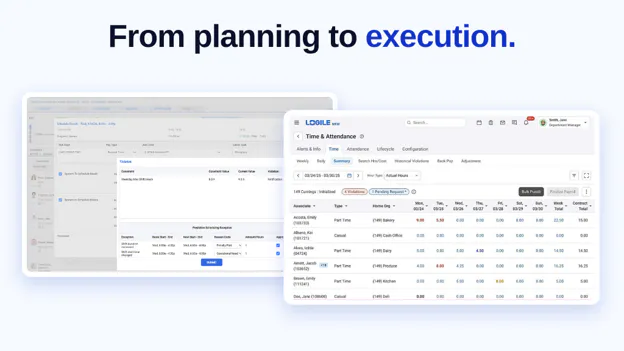
Because the most effective way to manage compliance risk is not simply to identify problems faster.
It is to plan more effectively so fewer avoidable problems arise in the first place.
Plan for peak demand without compromising your workforce
Discover how Logile helps retailers connect labor planning, scheduling and compliance to deliver better customer experiences, support associates and manage workforce requirements with greater confidence.
Recent Posts
Shoppers Are Abandoning $113 Shopping Trips When Stores Aren’t Ready for the Rush
2026-11-12
Shoppers abandon trips worth $113 when stores aren’t ready for the rush. See how peak-hour understaffing shapes where they spend.
Read More
When Every Degree Matters: Rethinking Food Safety in Grocery Retail
2026-11-11
Learn how continuous temperature monitoring helps grocers detect refrigeration issues earlier, reduce manual checks and coordinate food safety responses.
Read More
Four Peaks, One Team: What the Rest of the Holiday Season Will Ask of Your Stores
2026-11-06
Plan retail labor for promotions, Cyber Week, gifting and returns. Connect changing holiday demand to staffing, budgets and better 2027 planning.
Read More