
Artificial intelligence has quickly moved from an emerging technology to an executive priority. Across retail, organizations are investing in AI capabilities, developing governance policies, hiring dedicated leaders, and exploring how intelligent technology can improve everything from customer experiences to store operations all the way to their bottom lines.
The conversation is also beginning to change.
The initial question was: How quickly can we adopt AI?
Today, retail leaders are asking a more important question: What measurable value are we getting from it?
AI adoption alone does not improve operational performance. Sustainable value depends on where the technology is applied, the quality and connectivity of the data supporting it, the maturity of the underlying processes, and the ability of people to validate its recommendations and turn insights into action.
For retailers looking to move beyond experimentation, the path to AI ROI may begin with readiness rather than technology.
AI Innovation Is Not the Same as AI Value
The pressure to invest in AI is real. Retail leaders are regularly told that competitors are moving faster, automating more work, and gaining an advantage through new technology.
That pressure can encourage organizations to prioritize speed over strategy.
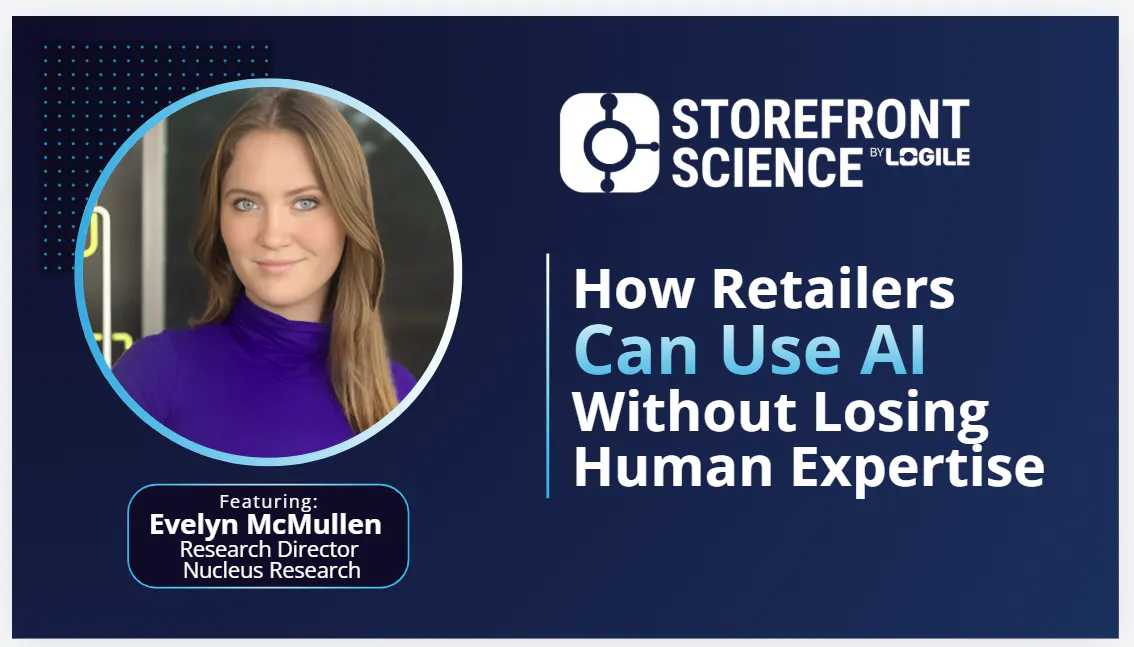
During a recent episode of Storefront Science, Evelyn McMullen, Research Director at Nucleus Research, explained that the value of AI depends heavily on where and how it is applied.
Retailers should begin by asking two questions:
- How mature is the process we want AI to support?
- Where are the organization’s largest operational challenges?
The most visible or innovative AI application may not deliver the greatest return. A targeted use case that improves an established, high-impact operational process may create more measurable value than a highly experimental initiative.
Retailers should identify persistent operational challenges first, then determine where AI can improve decisions, increase efficiency, or give store teams more time to focus on higher-value work.
What Does It Mean for a Retailer to Be AI-Ready?
AI is often positioned as a turnkey solution. In practice, organizations may have significant foundational work to complete before the technology can consistently deliver accurate and actionable outcomes.
AI readiness includes several interconnected components:
- Clean, reliable, and accessible data
- Connected systems that provide a consistent operational picture
- Mature and clearly defined business processes
- Governance policies and organizational guardrails
- Alignment among executives, operational leaders, technology teams, and end users
- A phased plan for implementation, measurement, and scale
Without these foundations, retailers risk layering AI onto fragmented technology environments and inconsistent processes.
The result may be another disconnected tool that produces incomplete recommendations, creates additional complexity, or introduces new risks into operational decision-making.
Connected data is especially important because retail operations are highly interdependent. Forecasting affects labor planning. Labor plans influence schedules. Schedules affect task execution, customer service, employee experience, and operational performance.
AI cannot reliably optimize those relationships if the information supporting them remains fragmented across disconnected systems.
Start With the Operational Problems That Matter Most
Retailers do not need to apply AI everywhere to create value.
The strongest opportunities may exist in repetitive, time-consuming processes where organizations already understand the inputs, workflows, and desired outcomes.
Store managers are a clear example.
Managers frequently spend significant time completing administrative work in back offices when their experience may create more value on the sales floor. Time spent manually building schedules, responding to routine changes, reviewing operational information, or reconciling disconnected systems is time that cannot be spent coaching employees, supporting customers, or improving store execution.
AI can help reduce that administrative burden by synthesizing large amounts of information and accelerating routine decisions.
Potential applications include:
- Demand forecasting
- Workforce forecasting
- Labor planning
- Employee scheduling
- Schedule optimization
- Administrative workflow automation
- Operational exception identification
- Returns-fraud detection
Forecasting and scheduling may be particularly strong opportunities because many retailers already use machine learning and advanced analytics within these processes. Adding new AI capabilities to an established operational foundation may be more practical than introducing AI into an entirely new or immature workflow.
The objective is not simply to automate more work. It is to help employees make stronger decisions and redirect time toward activities where human expertise creates greater value.
Retail AI Needs Governance and Guardrails
AI implementation should not begin with unrestricted access and an expectation that the technology will independently generate value.
Retailers need clear governance structures that define:
- Which decisions AI can support
- Which decisions require human review
- How recommendations are validated
- Who is accountable for outcomes
- How models and outputs are evaluated
- How organizational and customer data is protected
- How AI performance will be measured over time
Governance becomes increasingly important as AI moves closer to operational decision-making.
Retail organizations operate within complex environments shaped by labor regulations, employee availability, customer expectations, store-level differences, compliance requirements, and changing demand. An AI recommendation may be mathematically sound while missing context that an experienced manager immediately recognizes.
Clear guardrails help organizations benefit from the speed and scale of AI while maintaining appropriate oversight.
Should Retailers Build or Buy AI Technology?
The build-versus-buy decision is not new, but AI introduces additional cost, risk, and complexity.
Building internally may provide greater customization, particularly for highly specialized use cases. It may also require significant investment in development, governance, model transparency, maintenance, infrastructure, and ongoing iteration.
For many regional and midmarket retailers, partnering with an experienced technology provider may offer a more practical path to value.
An established partner may already provide:
- Retail-specific data models
- Proven operational workflows
- Experience across multiple implementations
- Established governance practices
- Ongoing technology maintenance
- A clearer framework for measuring business outcomes
Retailers still need internal ownership, operational expertise, and governance. Technology cannot simply be implemented and forgotten.
However, working with a partner can reduce the cost and uncertainty associated with developing and maintaining complex AI capabilities independently.
Internal development may be best suited to highly differentiated use cases or controlled experimentation. For core operational functions, retailers should carefully evaluate whether building proprietary technology creates enough strategic value to justify the additional investment and risk.
Why Connected Operations Create the Foundation for AI
Some of the strongest technology ROI stories are not defined by AI alone.
They begin with unification.
Disconnected systems create fragmented information, inconsistent workflows, and limited operational visibility. Adding AI without addressing those challenges may amplify existing problems rather than solve them.
Retailers that connect forecasting, labor planning, scheduling, execution, and operational data create a stronger foundation for intelligent decision-making.
This allows AI to evaluate a more complete operational picture and helps teams understand how decisions in one area affect outcomes elsewhere.
The experience of Vallarta Supermarkets demonstrates the potential value of a connected approach. By assessing operational needs, prioritizing high-impact challenges, and implementing technology through a thoughtful, phased strategy, Vallarta created measurable value while minimizing disruption.
Its transformation was recognized as one of the leading technology ROI stories globally by Nucleus Research.
The lesson extends beyond a single implementation: successful AI strategies may depend on the operational foundation built before advanced capabilities are introduced.
Why Humans Will Remain Essential to Retail AI
AI can analyze large datasets, identify patterns, generate recommendations, and complete certain tasks faster than people.
What it does not possess is the lived experience of a store manager.
Retail professionals develop institutional knowledge through years of understanding customers, employees, departments, locations, operational tradeoffs, and unexpected events. That context often determines whether a recommendation will work in a real store environment.
Human oversight remains essential for validating AI outputs, identifying missing context, managing exceptions, and determining when a recommendation should be adjusted.
The future of retail operations is unlikely to be defined by people competing against AI. It will be shaped by organizations that determine how technology and human expertise can work together most effectively.
AI can accelerate analysis and automate repetitive work. People provide judgment, context, accountability, creativity, and operational experience.
The strongest outcomes will come from combining both.
How Can Retailers Measure the ROI of AI?
AI performance should be connected to measurable operational and financial outcomes rather than adoption alone.
Depending on the use case, retailers may evaluate:
- Manager hours returned to the sales floor
- Forecast accuracy
- Labor productivity
- Schedule quality and stability
- Overtime reduction
- Employee schedule satisfaction
- Customer service levels
- Store execution consistency
- Shrink reduction
- Administrative time savings
- Revenue improvement
- Margin impact
- Time to measurable value
Usage may indicate whether employees are engaging with a new capability, but adoption is not the same as business value.
Retailers should define the intended operational outcome before implementation, establish a baseline, and evaluate whether AI is creating measurable improvement.
The most important AI metric may not be how frequently the technology is used. It may be whether employees and operations perform better because of it.
The Path From Retail AI Adoption to ROI
Retailers do not need to adopt every new AI capability to remain competitive.
They need to identify where intelligent technology can address meaningful operational challenges and build the foundation required to use it responsibly.
That means connecting data, strengthening processes, establishing governance, involving end users, prioritizing measurable use cases, and maintaining human oversight.
AI is a powerful tool, but technology alone does not create transformation.
Value comes from applying the right capabilities to the right operational challenges, supported by reliable data and experienced people who understand how to turn recommendations into results.
For retail leaders evaluating their next AI investment, the most useful question may no longer be:
Where can we add AI?
It may be:
Where can AI help our people make better decisions and create measurable value?
Frequently Asked Questions
AI readiness is an organization’s ability to implement and scale artificial intelligence effectively. It typically requires reliable data, connected technology systems, mature operational processes, governance policies, stakeholder alignment, end-user involvement, and clear business objectives.
Retailers can improve AI ROI by prioritizing high-impact operational challenges, establishing measurable goals before implementation, improving data quality, connecting fragmented systems, involving end users, and measuring operational and financial outcomes over time.
Practical retail AI use cases include demand forecasting, workforce forecasting, labor planning, employee scheduling, schedule optimization, operational exception management, administrative automation, and returns-fraud detection.
Human oversight helps validate AI recommendations and account for operational context that may not exist within the underlying data. Experienced employees provide institutional knowledge, judgment, accountability, and an understanding of store-level conditions.
The decision depends on organizational resources, technical capabilities, operational complexity, and the uniqueness of the use case. Internal development may support highly specialized applications, while established technology partners may provide a faster and lower-risk path for core operational capabilities.
Retailers should connect AI performance to business outcomes such as forecast accuracy, manager time savings, labor productivity, schedule quality, overtime, employee experience, customer service, store execution, shrink, revenue, margin, and return on investment.
Watch The Full Conversation: How Retailers Can Use AI Without Losing Human Expertise
Want to go deeper? Watch the complete conversation with Evelyn McMullen, Research Director at Nucleus Research, as she shares practical insights on AI readiness, governance, measurable ROI, and why the most successful retailers use AI to empower people, not replace them.
Recent Posts
Holiday Is the Ultimate Test of Your Labor Plan
2026-10-05
Holiday puts every labor planning assumption to the test. See how retailers can model demand, staffing, service, and cost scenarios before stores have to.
Read More
Fresh Operations Industry Survey
2026-10-01
Logile’s survey of 200 retail leaders reveals fresh operations challenges across visibility, shrink, labor planning, AI and technology.
Read More
Back-to-School Is Ending: The Q4 Retail Rush Is Already Here
2026-09-01
Back-to-school is ending, but Q4 retail demand is already building. Learn how retailers can prepare labor plans for holiday traffic, promotions and fulfillment.
Read More