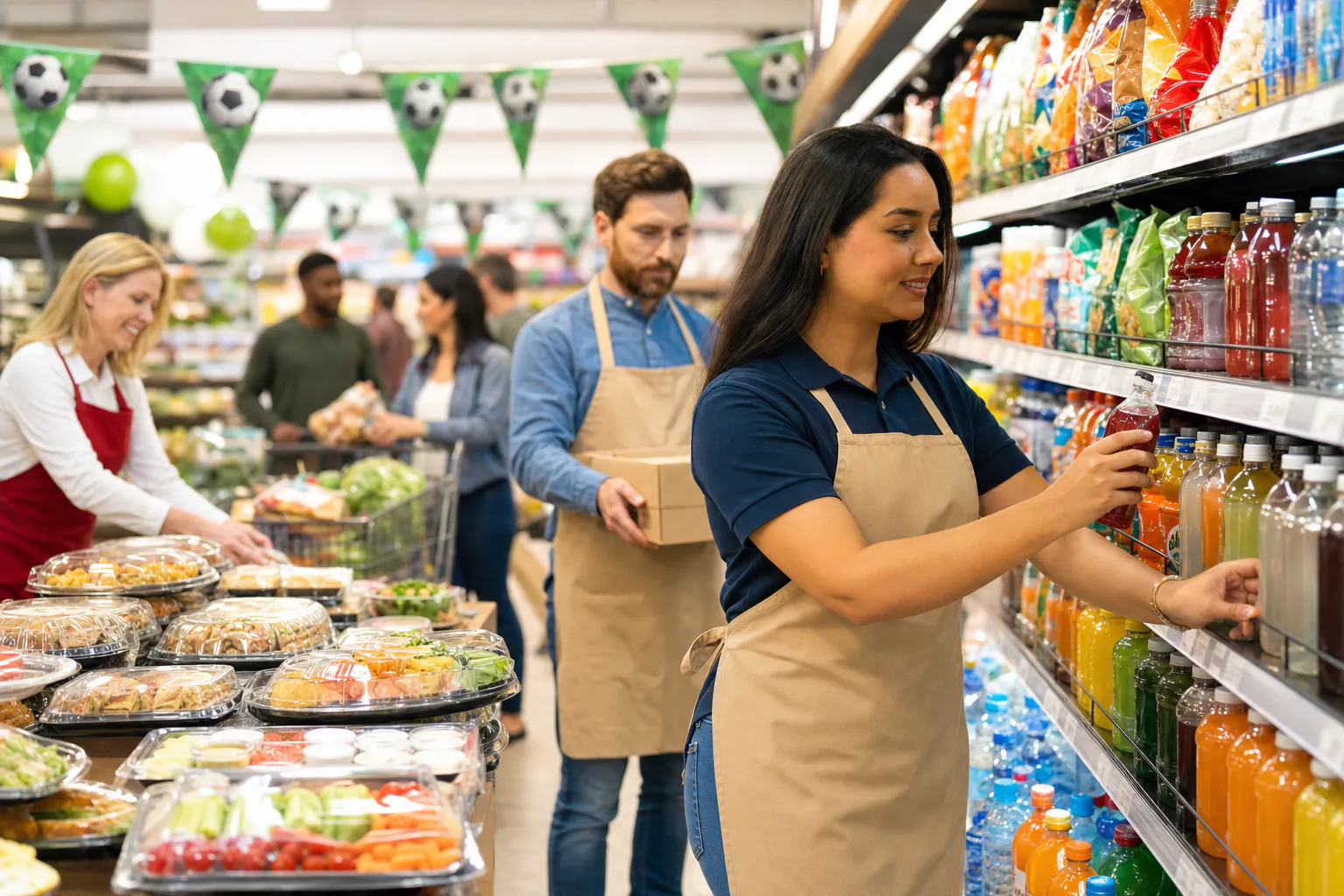
The biggest tournament in history has come to North America and to your aisles.
As the 2026 FIFA World Cup unfolds across the U.S., Canada, and Mexico, it's not just playing out in stadiums. It's playing out in grocery stores.
For 40 days and 104 matches, millions of households will gather to watch games, host friends and family, fire up grills, order party platters, and stock up on snacks, beverages, and ready-to-eat meals.
For grocers, it's one of the biggest sales opportunities of the year. The question isn't whether shoppers will spend. The question is whether your stores will be ready to capture the surge.
-- Every Match Is a Mini Holiday --
Think of the World Cup as a Super Bowl that lasts six weeks. Demand won't arrive all at once. It will come in waves driven by match schedules, popular teams, regional fan bases, and weekend viewing events.
Categories likely to benefit include:
- Fresh produce
- Meat and seafood
- Deli and prepared foods
- Bakery
- Snacks and beverages
- Grab-and-go meals
- Party trays and catering
Many retailers will focus on promotions, displays, and limited-time assortments. Those efforts matter, but they're only part of the equation.
The retailers that win during the World Cup won't simply be the ones with the most product on display. They'll be the ones that execute consistently when demand spikes and shoppers expect products to be available exactly when they want them.
-- Fresh Is the Real World Cup Battleground --
The biggest opportunity may not be in packaged goods. It may be in fresh. According to Logile's 2026 State of Fresh Grocery Shopping Report, 91% of shoppers say fresh departments influence whether they trust a grocery store. Nearly 8 in 10 have switched stores because another retailer's fresh departments looked better, and 46% would choose a store with better fresh departments over one with lower prices.
Those findings become even more important during an event that drives millions of game-day shopping trips. When shoppers are planning watch parties and game-day meals, fresh departments become destination departments. They're looking for fresh produce, deli platters, prepared meals, bakery items, grilling proteins, and convenient meal solutions.
The report also found that 68% of shoppers say hot prepared meals would encourage them to buy from a grocery store's deli or prepared foods section.
For grocers, fresh isn't just a category. It's an opportunity to increase basket size, drive repeat visits, and build loyalty throughout the tournament.
-- The Hidden Operational Challenge --
The World Cup won't just drive demand. It will create operational complexity.
Retailers will be managing new promotional products, limited-time assortments, themed displays, increased fresh production, and higher customer traffic all at the same time.
The challenge is that demand won't arrive evenly. Match schedules, team popularity, local fan engagement, and promotional activity can create sudden spikes that traditional plans weren't built to handle.
Fresh departments face an even greater challenge. Unlike packaged goods, fresh items can't simply be pulled from the back room when displays run low. Production takes time, shelf lives are short, demand changes throughout the day, and stores must have the right associates available to prepare and replenish products when shoppers are ready to buy.
Without accurate forecasting, demand-aligned labor, and coordinated execution, stores risk stockouts, excess shrink, empty displays, and missed sales opportunities precisely when shoppers are most engaged.
The retailers that win during the World Cup will be the ones that keep forecasting, labor, fresh production, inventory, and store execution working together.
-- Your World Cup Readiness Playbook --
Forecast the Surge
World Cup demand won't follow historical patterns. Retailers need forecasting that accounts for match schedules, local market dynamics, promotions, and store-specific demand to keep the right products available when shoppers want them.
Match Labor to Demand
Traffic spikes, replenishment needs, and fresh production requirements will vary throughout the tournament. Aligning labor with demand helps stores maintain service levels while controlling costs.
Keep Fresh Ready, Not Wasted
Prepared foods, deli, bakery, produce, and meat departments will face increased demand. Retailers must not only forecast what products shoppers will want, but also align labor to production and replenishment schedules so fresh items are available when demand peaks. Connecting forecasting, production planning, labor, and inventory helps keep fresh items available while minimizing shrink and controlling labor costs.
Execute With Precision
Promotions create additional work across merchandising, replenishment, and compliance. Clear priorities and consistent execution help ensure stores are ready when demand peaks.
-- Turning World Cup Demand Into Loyalty --
The World Cup creates a significant opportunity for grocers, but success won't be determined by promotions alone.
The retailers that keep fresh departments stocked, align labor with demand, and execute consistently throughout the tournament will earn more than sales. They'll earn customer loyalty.
Because winning the World Cup isn't about stocking the most product. It's about executing better than the competition. The World Cup creates demand. Operations determines whether you capture it.
For more information on how Logile can help grocers connect forecasting, labor planning, fresh operations, inventory, and store execution, reach out today.
Recap: How can grocers prepare for the 2026 World Cup?
Grocers can prepare for the 2026 World Cup by forecasting demand around match schedules, aligning labor to traffic and fresh production needs, increasing readiness in deli, bakery, produce, meat, seafood, snacks, beverages, and prepared foods, and coordinating store execution so promotions, replenishment, and service levels hold up during demand spikes.
World Cup Grocery Readiness Checklist
- Forecast demand by match schedule, market, team popularity, and store location
- Build labor plans around traffic spikes and fresh production needs
- Prepare deli, bakery, produce, meat, seafood, and prepared foods for event-driven demand
- Coordinate promotions, displays, replenishment, and task execution
- Monitor shrink, availability, and service levels throughout the tournament
FAQs
Grocers can prepare for World Cup demand by aligning forecasts, labor plans, production schedules, inventory, promotions, and store execution around match schedules, local fan interest, and expected shopping patterns.
Fresh departments, deli, prepared foods, bakery, meat, seafood, produce, snacks, beverages, and grab-and-go meals are often most affected because shoppers are planning watch parties, quick meals, and event-driven gatherings.
Forecasting helps grocers anticipate traffic, demand, labor needs, fresh production, replenishment, and shrink risk so stores can stay in stock, staffed, and ready during event-driven demand spikes.
Recent Posts
Holiday Is the Ultimate Test of Your Labor Plan
2026-10-05
Holiday puts every labor planning assumption to the test. See how retailers can model demand, staffing, service, and cost scenarios before stores have to.
Read More
Fresh Operations Industry Survey
2026-10-01
Logile’s survey of 200 retail leaders reveals fresh operations challenges across visibility, shrink, labor planning, AI and technology.
Read More
Back-to-School Is Ending: The Q4 Retail Rush Is Already Here
2026-09-01
Back-to-school is ending, but Q4 retail demand is already building. Learn how retailers can prepare labor plans for holiday traffic, promotions and fulfillment.
Read More