
Grocery Leaders Rate Their Fresh Operations Successful. The Economics Tell a More Complicated Story.
Nearly 9 in 10 retail decision-makers call their fresh operations a success. So why do 74% admit they can't clearly see what's happening inside those same departments?
Grocery fresh departments are getting harder to run. Execution drifts across hundreds of locations, shrink eats margin, food safety rules keep tightening, and labor keeps getting more expensive. Yet ask senior retail decision-makers whether they manage fresh well, and almost all say yes.
A new Logile survey asked 200 senior decision-makers in grocery and multi-location retail to grade their own fresh operations. Their confidence was real but so were the concerns they raised, indicating that the economics of fresh are hard to see, even for the people running it.
The Logile 2026 State of Fresh Grocery Operations Industry Report follows its Logile 2026 State of Fresh Grocery Shopping Report, which found 91% of shoppers judge a grocery store by its fresh departments.
This report looks at the other side of the counter: how the grocery leaders responsible for fresh departments are actually managing them.
About the Logile 2026 State of Fresh Grocery Operations Industry Report
The Logile 2026 State of Fresh Grocery Operations Industry Report was conducted by the third-party survey platform CensusWide in May 2026, surveying 200 U.S. senior decision-makers at grocery and multi-location retail organizations. Respondents worked in store operations, fresh and perishable categories, inventory, supply chain, labor planning, and food safety and compliance. The survey measured how retail leaders manage their fresh operations, where they invest in technology, and where the gap between performance and perception runs widest.
Key findings of the Logile 2026 State of Fresh Grocery Operations Industry Report
- 89% of retail decision-makers rate their fresh operations as successful, with just 2% calling them unsuccessful.
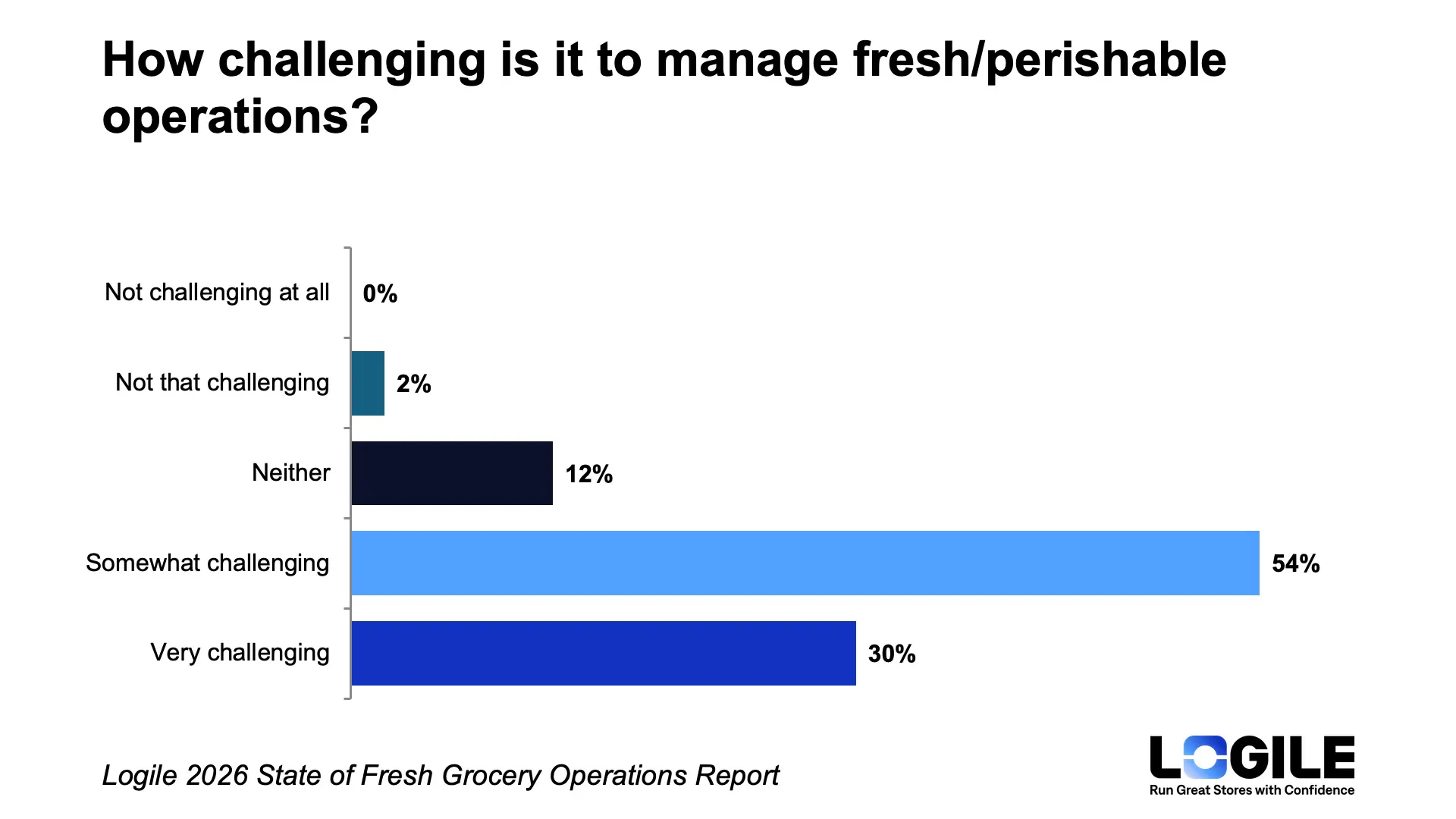
- 84% say managing fresh is challenging, 76% say cross-location consistency is hard to maintain, and 74% admit they can't clearly see what's happening across their own fresh departments.
- Large retailers (5,000+ employees) report more difficulty than mid-size peers on every pain point measured. 41% call managing fresh "very challenging," nearly double the 21% at mid-size organizations.
- 82% agree fresh departments play a major role in how customers perceive their stores, echoing earlier data showing that 91% of shoppers say fresh makes or breaks where they shop.
- 82% agree shrink and waste reduction is a growing business priority, rising to 90% at the largest organizations.
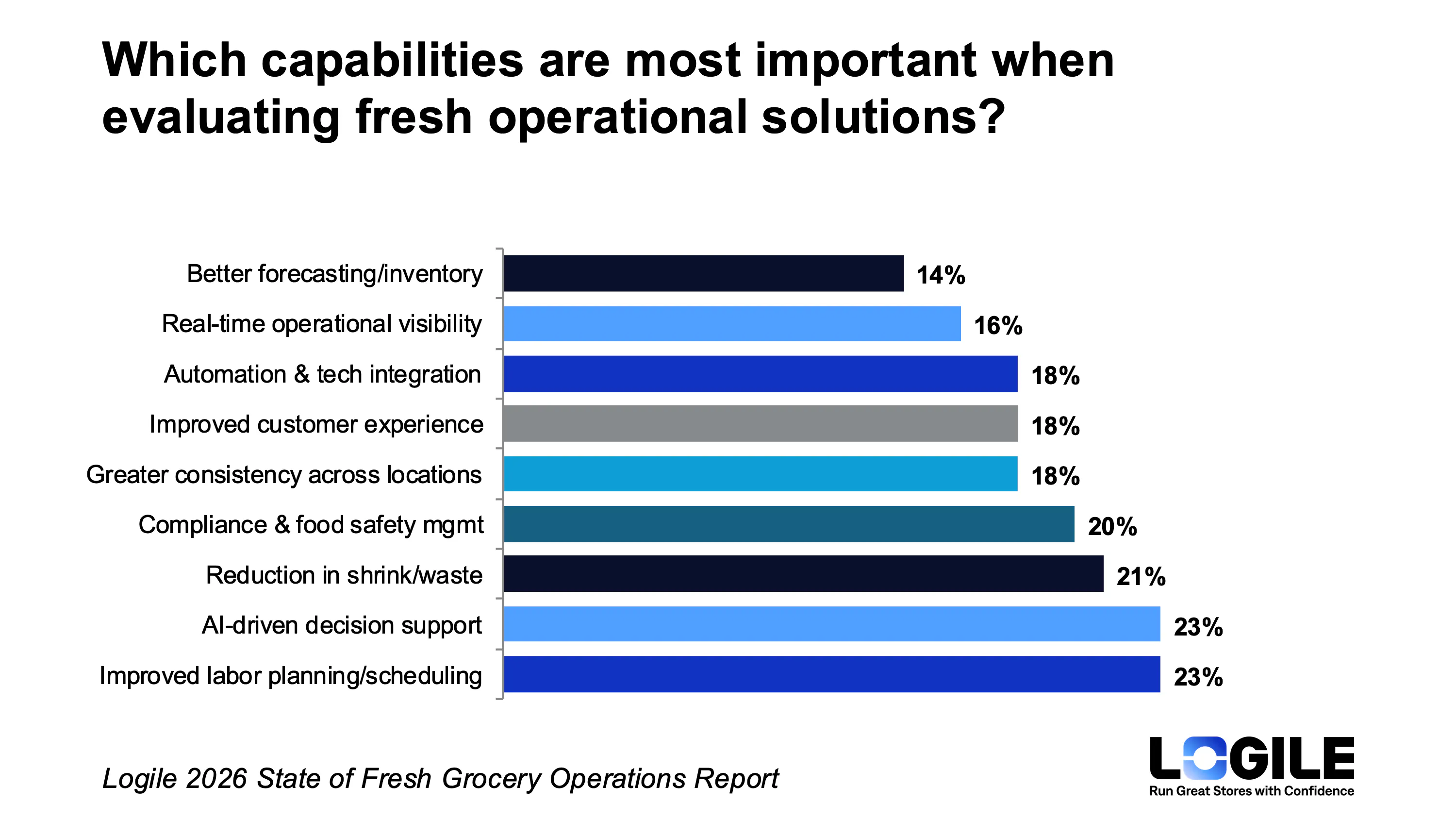
- 91% say investing in fresh operational technology is important. Asked what they want most, AI-driven decision support and better labor planning tie at the top at 23%.
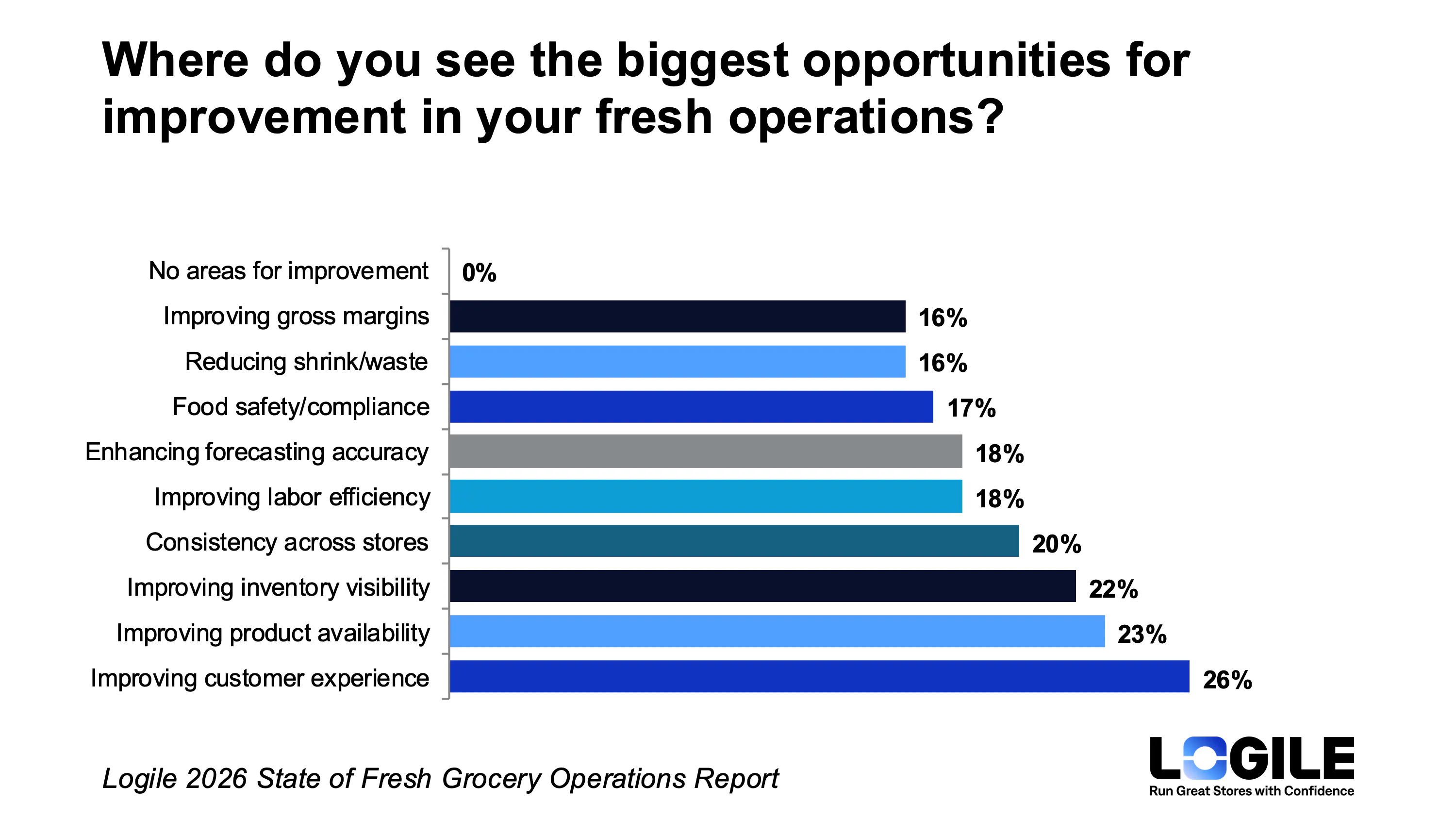
- Across nine improvement opportunities, not a single respondent chose "no areas for improvement."
"Retailers have every reason to be proud of their fresh departments. Teams work incredibly hard to run them well. What this data shows is that the true economics of fresh operations are scattered across so many systems that even the best operators can't see them clearly. You can't manage what you can't see, and right now most retailers are making fresh decisions without a complete view of the business."
— Purna Mishra, Founder and CEO, Logile
Why retailers rate fresh operations "successful" while admitting major gaps
89% of retail decision-makers rate their fresh operations as "successful." However, 74% admit their organization struggles to see across its own fresh departments. Logile 2026 State of Fresh Grocery Operations Industry Report
Asked how well their organization manages fresh and perishable operations, 89% said successful, including 36% very successful. Just 2% said unsuccessful.
Then, they named the gaps. 84% called managing fresh challenging. 76% said
consistency across locations is hard to maintain. 74% admitted they struggle to see what's happening across their fresh departments, including 36% who strongly agree.
The reason is simple: fresh economics live in too many places at once. Recipes, labor standards, schedules, inventory, and shrink reports each sit in a different system, so what an item really costs rarely shows up in one view.
Size sharpens the point. Large retailers (5,000+ employees) were more likely than mid-size peers to call themselves very successful, 42% versus 32%, even while reporting more difficulty on every dimension.
Why fresh operations get harder to manage at scale
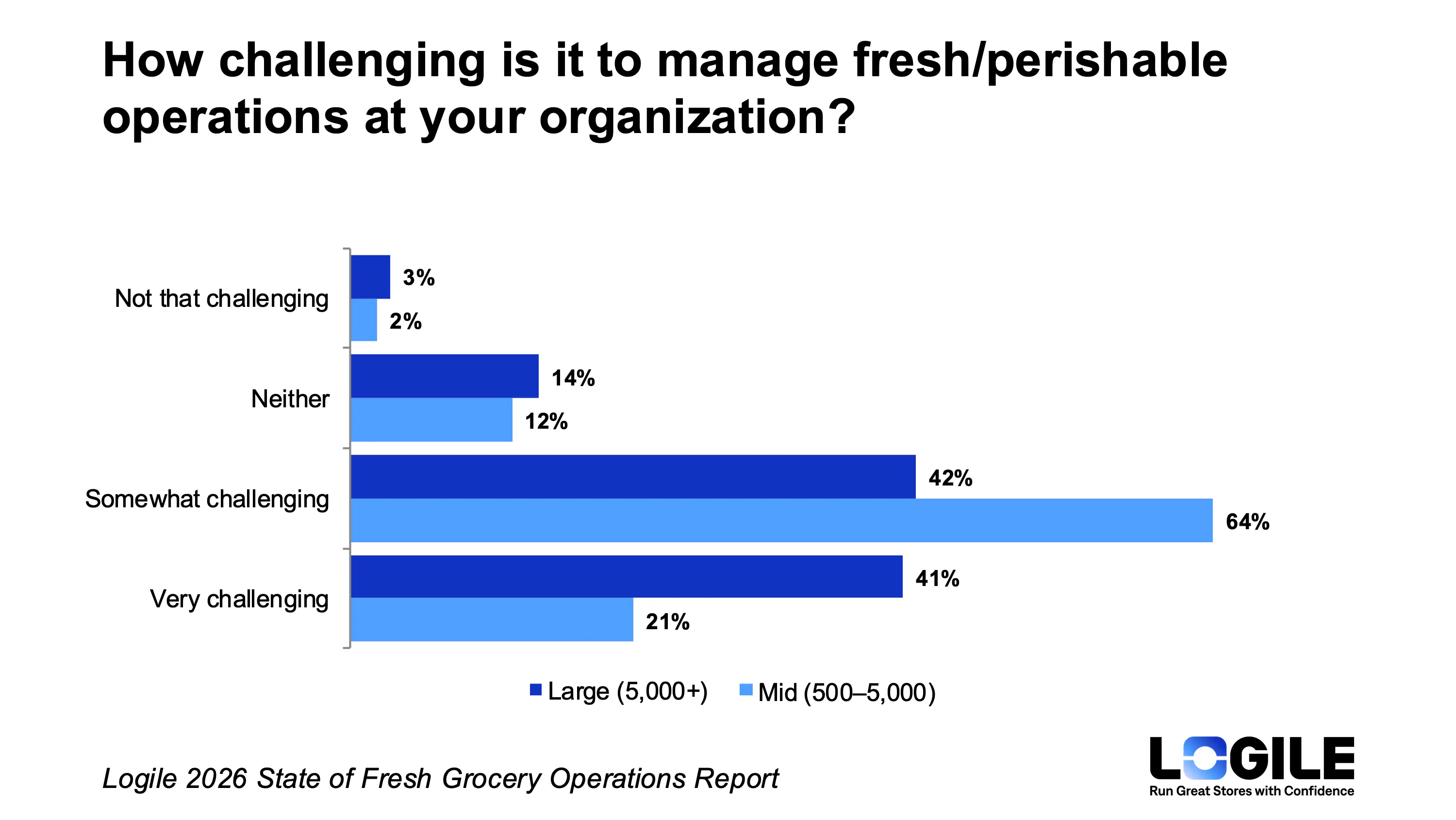
41% of large retailers (5,000+ employees) call managing fresh "very challenging." That's nearly double the 21% of mid-size retailers who say the same. Logile 2026 State of Fresh Grocery Operations Industry Report
Scale should make fresh easier. Bigger retailers have more resources, more buying power, and more data. Logile's survey found the opposite: with fresh operations management, the largest retailers struggle more, not less.
Across six common pain points, large retailers reported more difficulty on every one. They were likelier to call shrink and waste a growing priority (90% versus 75%), to say consistency across locations is hard to maintain (88% versus 67%), and to admit they can't see across their own fresh departments (82% versus 69%). Nothing got easier as organizations grew.
The clearest example is how hard fresh is to manage in the first place. Just 21% of mid-size retailers call it "very challenging," a figure that doubles to 41% among retailers with 5,000+ employees.
This challenge is structural: with more locations come more variation to control and more labor to coordinate, and each item's true cost slips further out of view. That's the problem a unified platform connecting forecasting, labor, and fresh production is built to solve.
Shrink hits the biggest chains hardest. Among large retailers, 49% strongly agree that reducing shrink and waste is a growing priority, versus 31% of mid-size operators.
The biggest fresh department challenges: shrink, labor, and customer perception
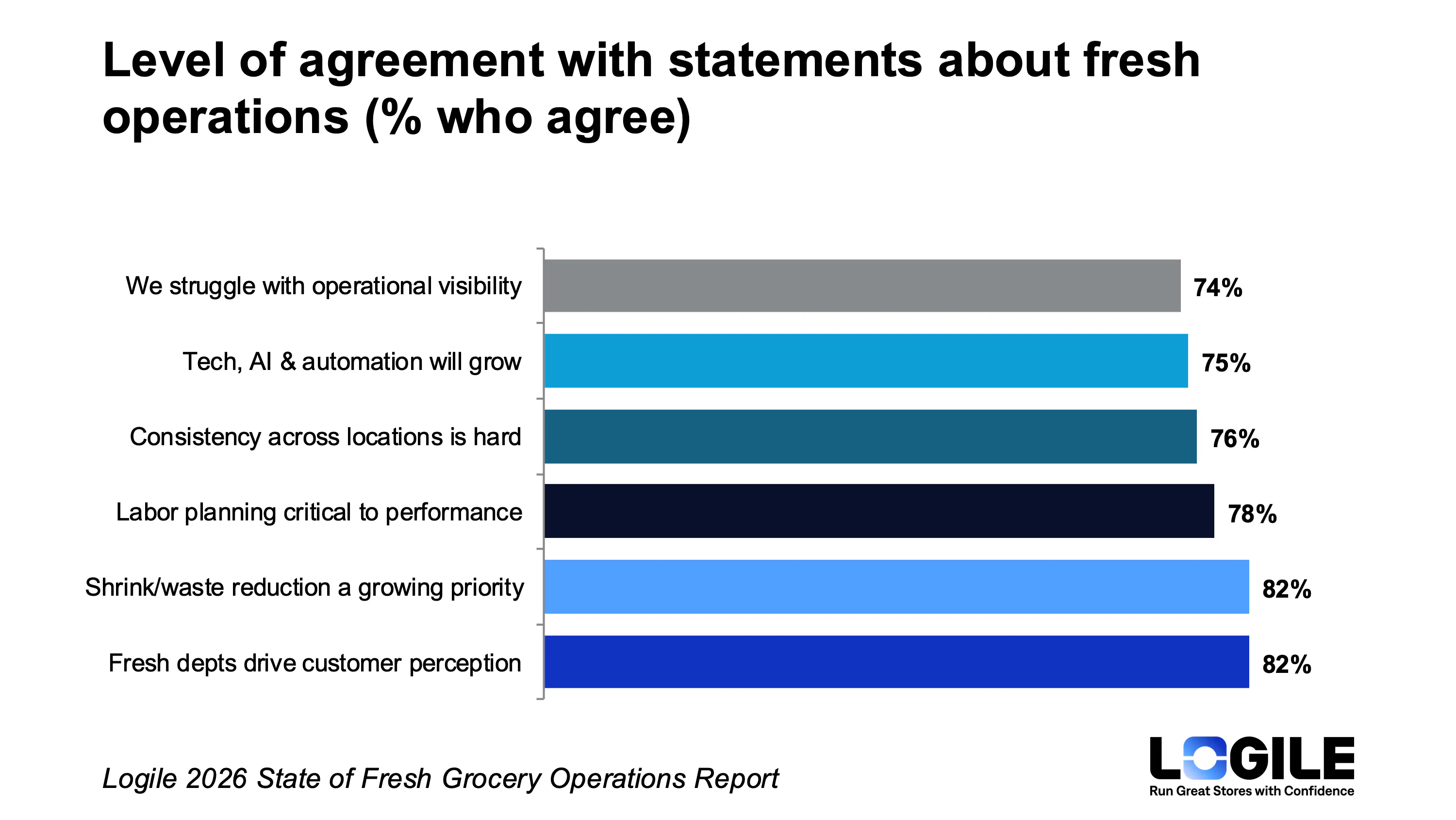
82% of retail decision-makers agree shrink and waste reduction is a growing business priority. Among large retailers that reaches 90%, with 49% agreeing strongly. Logile 2026 State of Fresh Grocery Operations Industry Report
When decision-makers weighed in on what's putting the most pressure on fresh, three concerns rose above the rest: how fresh shapes customer perception, the fight to control shrink, and the cost of labor.
The first is customer perception. 82% agree fresh departments play a major role in how customers see their stores, the operator-side echo of the 91% of shoppers who judge a store by its fresh departments.
The second is shrink, which is margin walking out the door at close. 82% call shrink and waste reduction a growing priority, 39% strongly. Reducing waste and shrink already dominates retail technology spending, and the data says the pressure is building. Most shrink traces back to production decisions, how much to batch and when, not the sales floor, which is why it's so hard to fix after the fact.
The third is labor. 78% call labor planning critical to fresh performance, 34% strongly, rising to 88% at large retailers. Fresh production runs on different rhythms than the rest of the store, so labor planning and scheduling needs more precision than a general-purpose tool offers. Treated as a fixed budget line, labor stays opaque; tied to what's actually being made, it becomes manageable.
Ask operators to name their single biggest priority for the next 12 months, and the answers scatter: operational visibility is 16%, automation and AI is 15%, food safety and compliance is 14%, with customer experience, shrink, and consistency close behind.
What retailers want most from fresh operations technology and AI
91% of retail decision-makers say investing in fresh operational technology is important. AI-driven decision support ties as the single most-requested capability. Logile 2026 State of Fresh Grocery Operations Industry Report
Operators are specific about what they want from technology.
91% say investing in fresh operational technology is important, and 42% extremely so. 51% of large retailers call it extremely important, while mid-size retailers lean somewhat important at 60%. Both rate it important; large retailers simply feel more urgency.
Asked which capabilities matter most, respondents tied two at the top: AI-driven decision support and improved labor planning, each 23%. Shrink and waste reduction followed at 21%, compliance and food safety at 20%.
Together they describe a single system that delivers something operators rarely have: a live view of what each fresh item costs to make and contributes back.
The ranking shifts by size. At large retailers, AI-driven decision support and shrink reduction tie at 26%, with consistency third at 24%. At mid-size operators, labor planning leads at 28%, then automation and technology integration at 22%.
75% agree technology, AI, and automation will only grow more important in fresh, rising to 84% among large retailers.
Where retailers see the biggest opportunities to improve fresh operations
Not one of the 200 senior decision-makers surveyed chose "no areas for improvement" when asked where fresh operations could get better. Logile 2026 State of Fresh Grocery Operations Industry Report
Asked where the biggest improvement opportunities lie, responses were spread across nine categories: customer experience at 26%, product availability at 23%, inventory visibility at 22%, with consistency, labor efficiency, and forecasting close behind.
Where the gaps feel sharpest depends on the operator. Large retailers point to forecasting and shrink; mid-size operators to inventory visibility and consistency. Data-driven organizations name consistency and customer experience first, while the reactive majority lands on availability and customer experience, with a stronger appetite for AI and shrink relief.
Food safety and compliance sits third or fourth in every segment, a steady concern that jumps to the front whenever regulatory pressure rises.
"The next chapter in fresh operations isn't about asking teams to work harder. They're already at capacity. It's about giving them a single, live view of what each item actually costs to produce and what it contributes back. When you connect forecasting, labor, production, and shrink in one place, fresh operations stops being a guessing game and becomes something you can manage. The retailers who make that shift first will set the standard for everyone else."
— Purna Mishra, Founder and CEO, Logile
Frequently asked questions about the Logile 2026 State of Fresh Grocery Operations Industry Report
Fresh operations management is how a grocery or multi-location retailer runs its perishable and ultra perishable departments – produce, meat, seafood, deli, bakery, and prepared foods – across demand forecasting, in-store production planning, labor scheduling, food safety, and shrink control. It's a growing priority: in the Logile 2026 State of Fresh Grocery Operations Industry Report, 91% of retail decision-makers call investing in fresh operational technology important and 84% call managing fresh challenging.
Fresh departments drive how shoppers judge the whole store. 82% of retail decision-makers in the Logile 2026 State of Fresh Grocery Operations Industry Report say fresh plays a major role in customer perception, and Logile's consumer research found 91% of shoppers judge a grocery store by the quality of its fresh departments.
The Logile 2026 State of Fresh Grocery Operations Industry Report found four: cross-location consistency (76% call it hard to maintain), operational visibility (74% struggle to see across departments), shrink and waste (82% call reduction a growing priority), and labor planning (78% call it critical). Overall, 84% describe managing fresh as challenging.
Most fresh shrink starts with production decisions – how much to batch and when – not the sales floor. Retailers cut it by sharpening demand forecasts, matching production and ordering to expected sales, and adding real-time visibility across departments so overproduction gets caught before it becomes waste. In the Logile 2026 State of Fresh Grocery Operations Industry Report, 82% of decision-makers call shrink and waste reduction a growing priority, rising to 90% at the largest retailers.
Fresh economics are scattered across systems – recipes, labor standards, schedules, inventory, and shrink reports each live somewhere different – so no single view shows what an item really costs. In the Logile 2026 State of Fresh Grocery Operations Industry Report, 74% of decision-makers say their organization struggles to see across its fresh departments. Connecting production, labor, shrink, and sales into a live, item-level view turns margin from a surprise into a managed outcome.
More locations mean more variation to control and more labor to coordinate. In the Logile 2026 State of Fresh Grocery Operations Industry Report, large retailers (5,000+ employees) reported more difficulty than mid-size peers on every measure: 41% called managing fresh "very challenging," double the 21% at mid-size organizations, and 90% called shrink reduction a growing priority versus 75%.
AI-driven decision support is the single most-requested capability in the Logile 2026 State of Fresh Grocery Operations Industry Report, tied at 23% with improved labor planning. It helps forecast perishable demand, guide in-store production, match labor to real production demand, and flag shrink and compliance risks in real time. 91% of decision-makers call investing in fresh technology important, and 75% expect AI and automation to grow more important in fresh.
In the Logile 2026 State of Fresh Grocery Operations Industry Report, respondents ranked AI-driven decision support and improved labor planning first (each 23%), followed by shrink and waste reduction (21%) and compliance and food safety management (20%) – pointing to demand for a single connected platform rather than separate point tools.
Recent Posts
What 1,000 Shoppers and 200 Retail Leaders Told Logile About Fresh Operations
2026-10-08
Fresh shapes where shoppers buy groceries and which stores they trust. Two Logile studies reveal a gap between shopper expectations and retailers’ visibility into fresh operations—and where grocers can focus their efforts.
Read More
Holiday Is the Ultimate Test of Your Labor Plan
2026-10-05
Holiday puts every labor planning assumption to the test. See how retailers can model demand, staffing, service, and cost scenarios before stores have to.
Read More
Back-to-School Is Ending: The Q4 Retail Rush Is Already Here
2026-09-01
Back-to-school is ending, but Q4 retail demand is already building. Learn how retailers can prepare labor plans for holiday traffic, promotions and fulfillment.
Read More