
9 in 10 Americans surveyed say fresh departments determine whether they trust a grocery store.
Grocery shoppers have never been more demanding about fresh food, and they’ve never been quicker to walk away when a store doesn’t deliver.
People have cared about the quality of fresh department items – produce, deli, bakery, meat, and more – for decades. What’s changed is how directly fresh departments now shape where people shop, how much they trust a store, and whether they’ll come back. When fresh departments look clean, full, and well cared for, they give shoppers an immediate reason to trust the store and come back. Fresh departments have become the single most powerful driver of trust and loyalty in the store.
Purpose of This Study
To understand how deeply fresh departments influence consumer behavior, Logile partnered with the third-party survey platform Pollfish in March 2026 to survey 1,000 U.S. consumers about their grocery shopping habits, preferences, and attitudes toward fresh food departments.
The findings of the Logile 2026 State of Fresh Grocery Shopping Report paint a stark picture: fresh departments aren’t just one of many factors shoppers consider. For most consumers, they’re the factor. The fresh category makes or breaks a store’s reputation, drives loyalty decisions, and keeps people coming back to physical retail in an era of growing online alternatives.
Key Findings of the Logile 2026 State of Fresh Grocery Shopping Report
- 91% of shoppers rate fresh departments as highly influential (4 or 5 out of 5) in determining whether they trust a grocery store, making fresh the dominant trust signal in the shopping experience.
- 78% of Americans surveyed have chosen to shop at a different grocery store because its fresh departments looked better, with 25% doing so frequently, showing that fresh quality directly drives competitive switching.
- 84% say a poorly maintained produce or fresh section affects their perception of the entire store “a great deal” or “quite a bit,” meaning one department’s execution can color the whole brand.
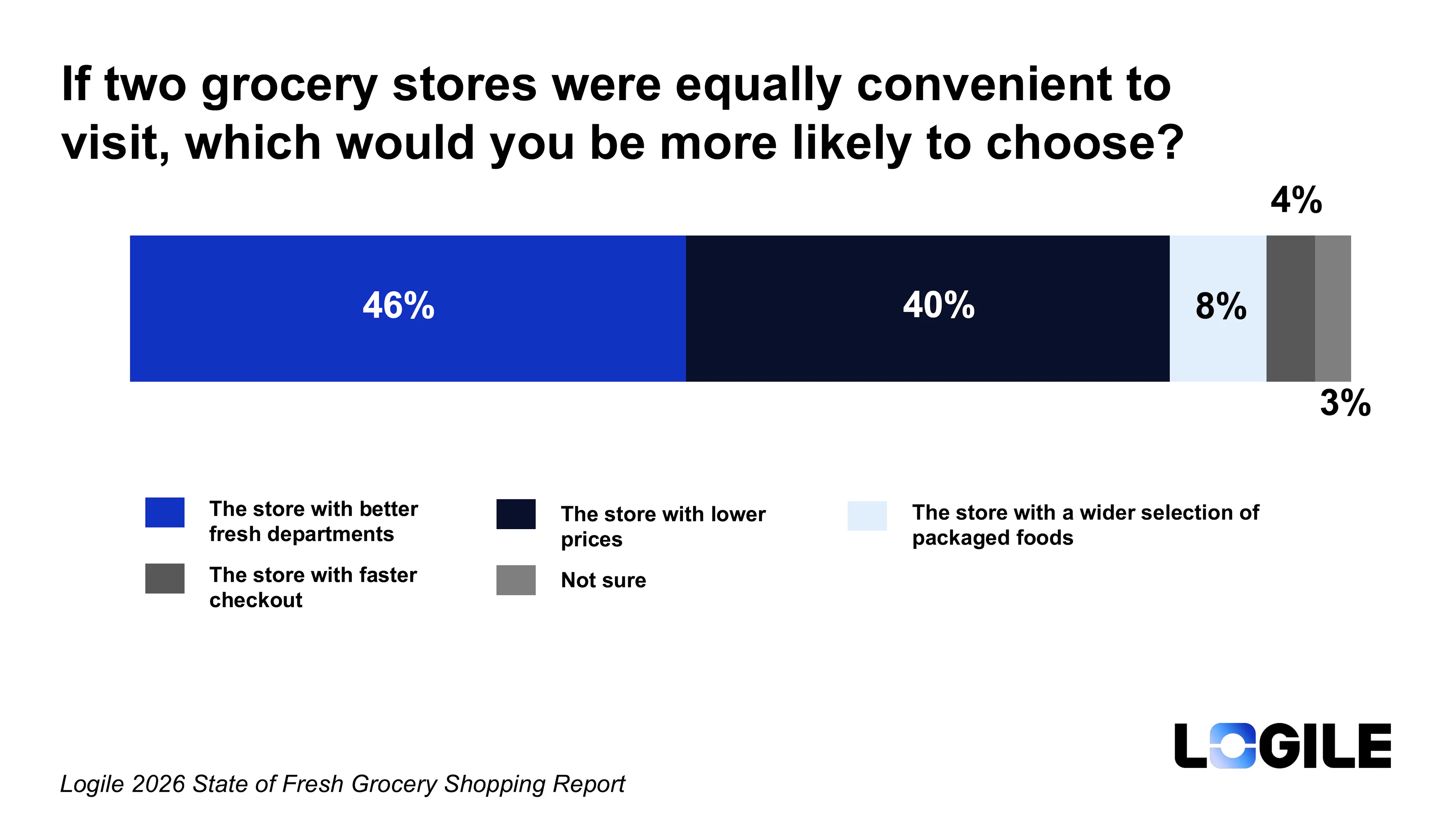
- When two stores are equally convenient, 46% of shoppers choose the one with better fresh departments over the one with lower prices (40%), a finding that challenges the assumption that price always wins.
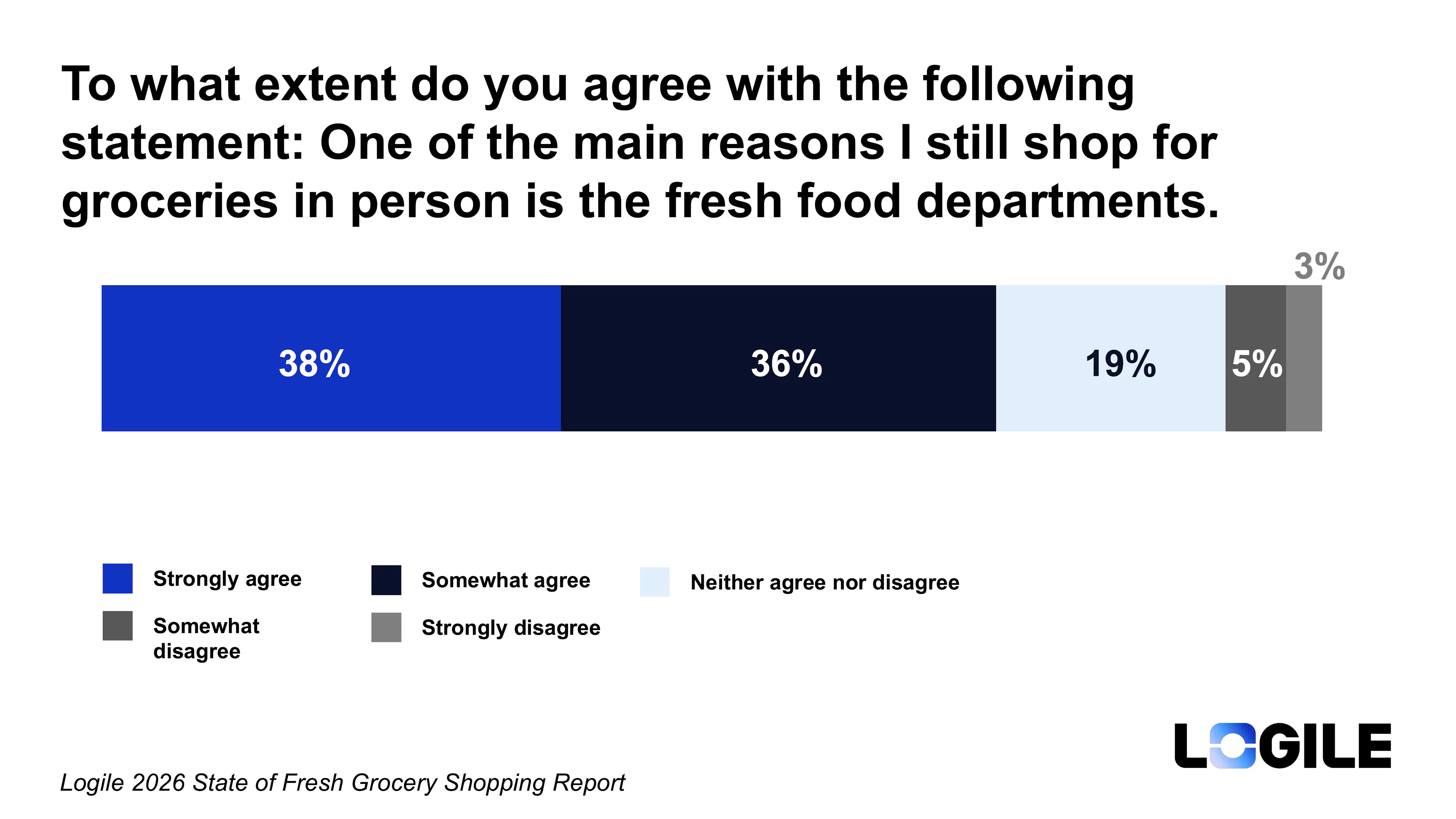
- 74% agree that fresh food is a main reason they still shop for groceries in person rather than online, making fresh departments the anchor that keeps customers in physical stores.
- 85% of shoppers say the appearance of produce is extremely or somewhat significant in their purchasing decisions, confirming that visual freshness directly drives what goes in the cart.
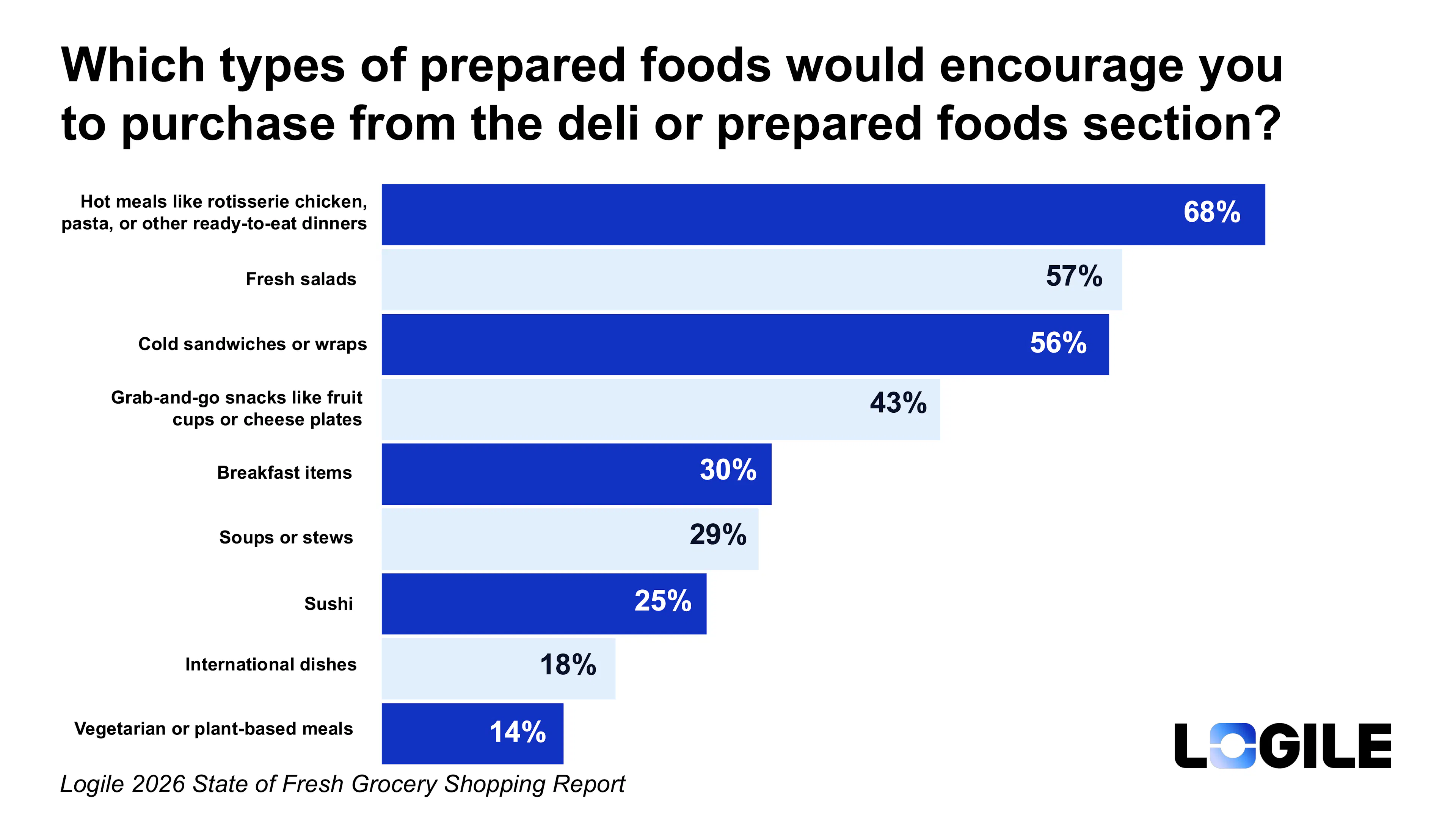
- Nearly 7 in 10 consumers (68%) say hot prepared meals like rotisserie chicken would encourage them to buy from a store’s deli section, pointing to major growth potential in prepared foods.
Purna Mishra, Founder and CEO of Logile, said:
“The data confirms what we see across our retail partners every day: fresh departments are a trust engine, not a cost center. When shoppers walk into a store and see full, well-maintained displays of fresh food, they make an instant judgment about the quality of the entire operation. That judgment drives where they shop, what they spend, and whether they come back.”
Fresh Departments Are Grocery’s Ultimate Trust Test
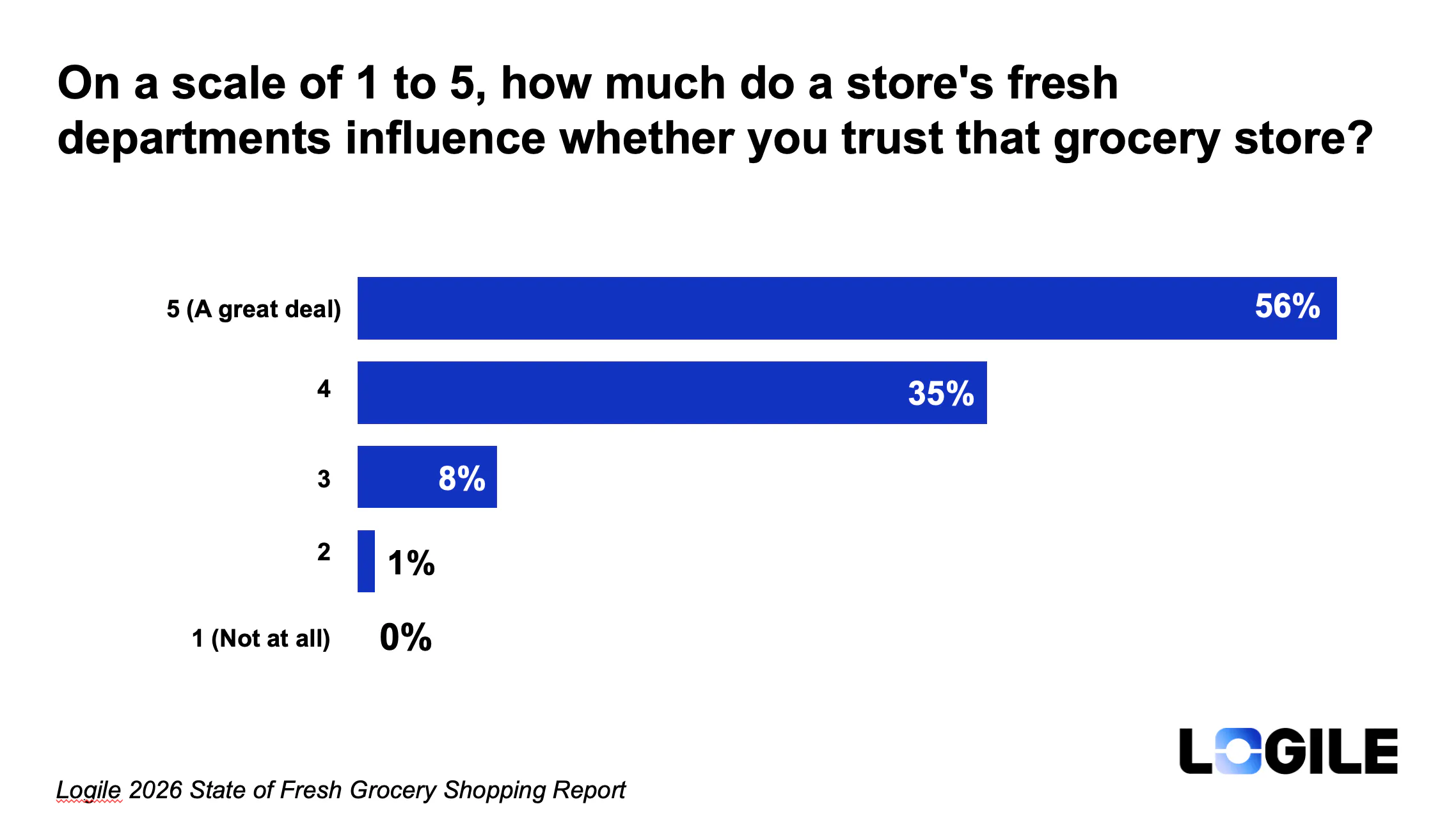
The survey asked shoppers to rate, on a scale of 1 to 5, how much a store’s fresh departments influence whether they trust that store. The results were overwhelming: 56% gave the highest possible rating, and another 35% rated it a 4 out of 5. Combined, 91% of respondents say fresh departments are a major factor in store trust.
That finding alone would be notable. But the spillover effect makes it even more significant. When a produce or fresh section looks poorly maintained, 84% say it changes how they perceive the entire store – 45% say “a great deal,” and 38% say “quite a bit.” The condition of the produce department shapes impressions of the store as a whole.
The upside is just as powerful. When fresh departments look clean, full, and well maintained, they create a storewide halo effect in the other direction too, signaling that the operation is well run and the food is worth buying. In other words, fresh is not only where trust can break. It is also where trust is built.
The trust signal cuts across regions and demographics. In the South, 62% gave the highest trust rating, compared to 49% in the Midwest and 50% in the Northeast. Parents rate trust influence even higher: 61% gave a 5 out of 5, compared to 52% of non-parents. Women were more likely to give trust influence the highest rating, with 58% rating it 5 out of 5, compared to 52% of men.
And when shoppers walk through the door, the first things they check tell the story. 44% say store cleanliness is their immediate diagnostic. Another 28% go straight to the produce section. Together, that’s 72% of shoppers performing an instant quality check tied directly to freshness and presentation.
Fresh Departments Directly Affect Customer Loyalty
Trust might get a customer in the door, but fresh execution determines whether they stay. The survey data revealed a striking pattern of competitive switching tied directly to fresh department quality.
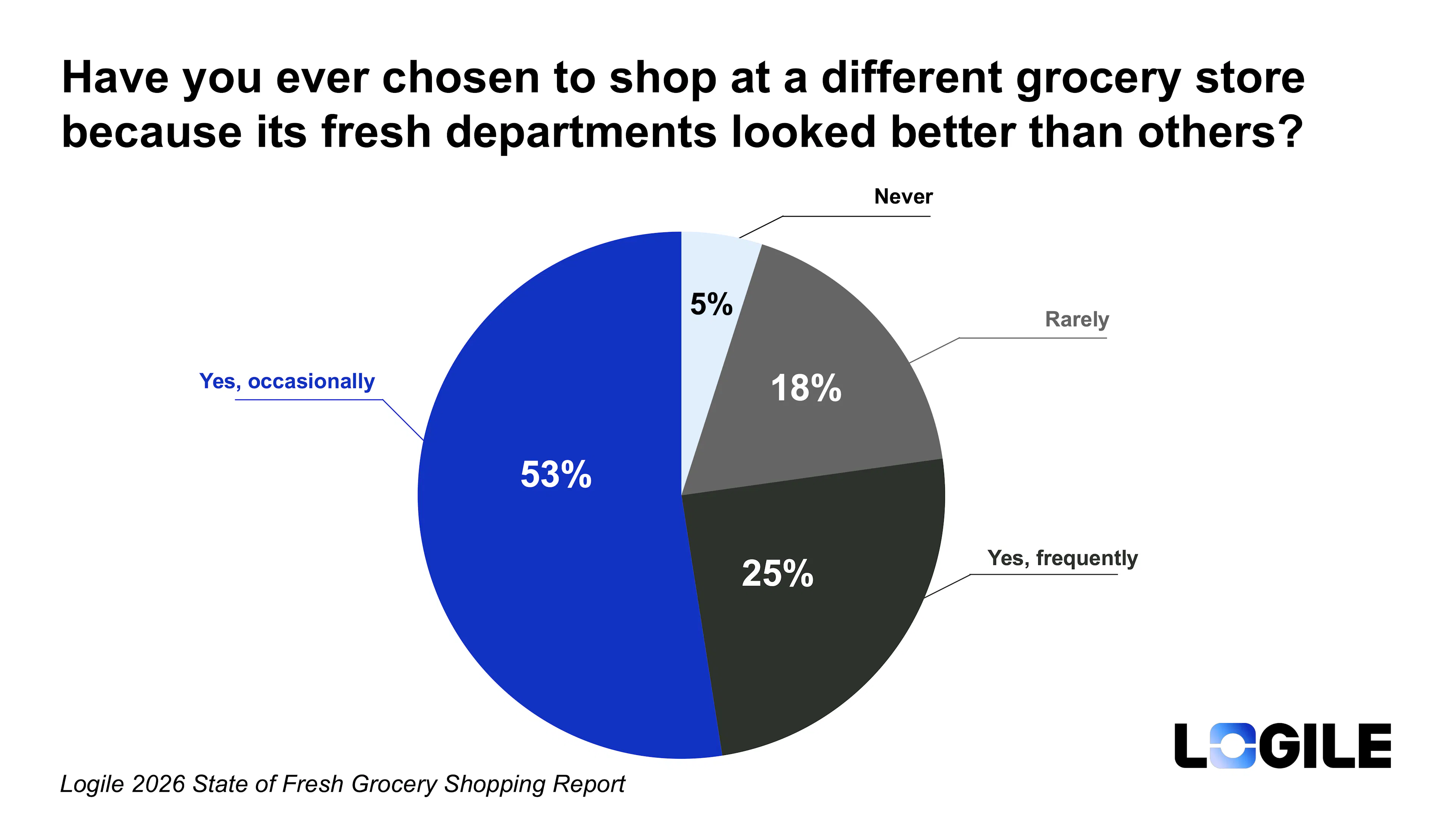
78% of shoppers say they’ve chosen a different grocery store because its fresh departments looked better than their usual store’s. A quarter of those – 25% of all respondents – say they do this frequently. Only 5% say they’ve never switched stores over fresh quality.
The flip side is just as telling. 75% report switching stores because they were unhappy with fresh departments. 48% say this happens sometimes, 17% often, and 9% very often. These results show that execution failures regularly drive shoppers to competing stores.
Fresh works like a real-time report card. When displays are full, clean, and clearly maintained, shoppers read it as a sign the store is dependable overall and they have less reason to second-guess the trip. Over time, that consistency turns fresh departments into a loyalty engine because it reinforces trust on every visit, instead of just when shoppers are comparing options.
Those signals are not limited to produce, and home meal replacement (HMR) is often where trust is won or lost fastest. Shoppers make the same snap judgments in HMR and other in-store produced areas, where appearance and taste are part of the promise. When prepared foods look fresh, are well presented, and turn over consistently, they reinforce the sense that the store is managed with care. When they look dried out, poorly held, or inconsistent from visit to visit, the trust hit can feel just as immediate because shoppers assume the same standards apply behind the scenes.
When asked what most quickly erodes trust, the top answer is clear: 43% say items that look old, spoiled, or not fresh. Unpleasant odors come next at 18%, followed by dirty displays at 15%. The triggers are sensory and immediate. Trust breaks down through what shoppers can see and smell and what they cannot find. When core fresh items look picked over or are missing altogether, it signals a department that is not being maintained in real time and shoppers notice quickly.
The Sensory Signals That Make or Break Freshness Perception
Shoppers judge freshness through a constellation of sensory cues, all of which depend on consistent, behind-the-scenes operational execution.
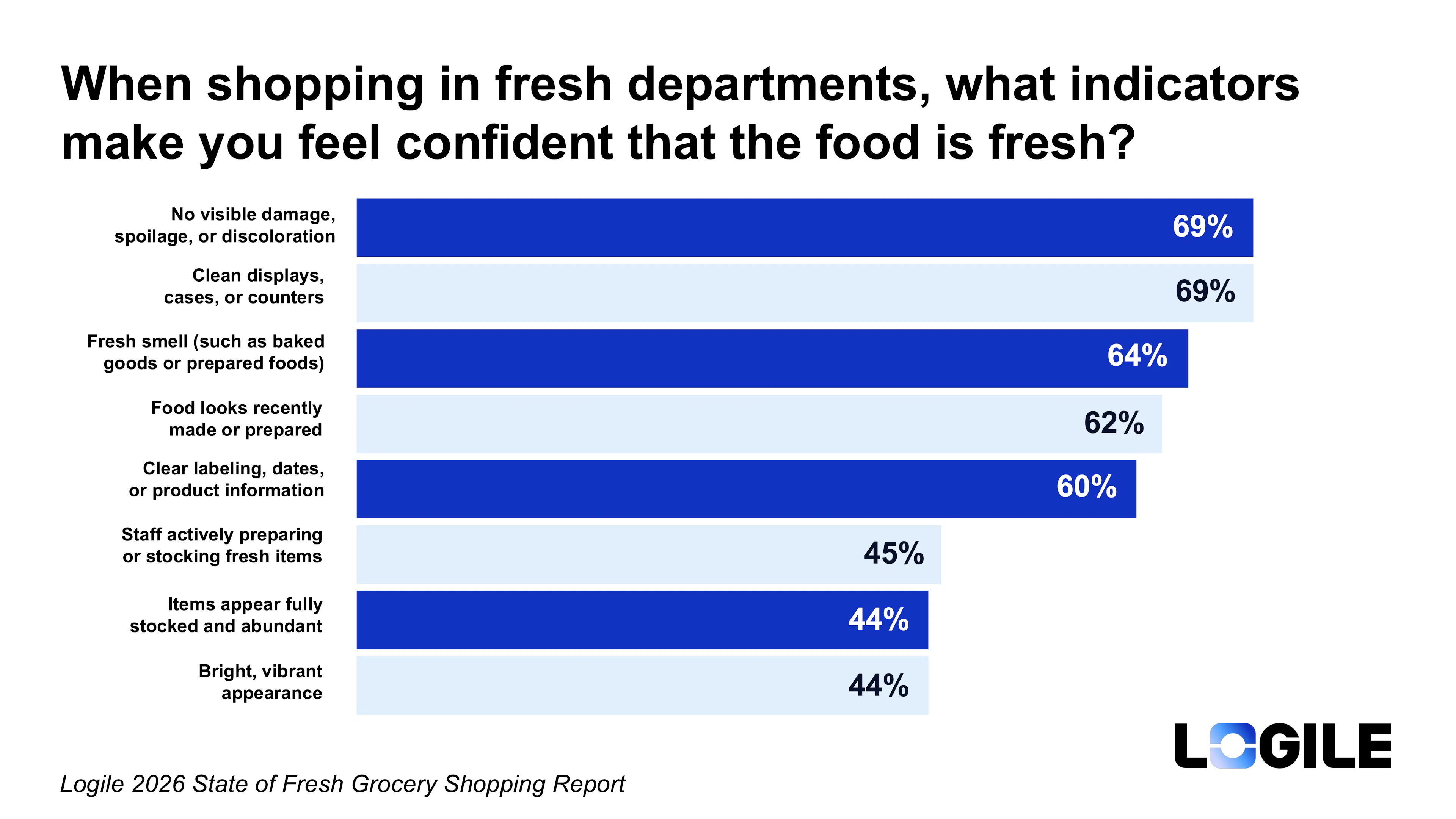
The top freshness indicators, selected from a multi-choice list: no visible damage, spoilage, or discoloration (69%), clean displays, cases, or counters (69%), fresh smell such as baked goods or prepared foods (64%), and food that looks recently made or prepared (62%). Clear labeling and dates round out the top five at 60%.
What’s notable is that price doesn't appear anywhere in this list. Freshness is judged first through visible condition and scent. The assessment is fast and instinctive: does this department look and smell like the food was made today?
Produce appearance carries especially heavy weight. 85% of shoppers say appearance is extremely or somewhat significant in their purchasing decisions. Among respondents earning more than $100K, 64% call it “extremely significant.” When produce looks vibrant and well cared for, it gives shoppers a quick reason to feel confident in what they are buying and in the store behind it, making it easier to choose fresh items and keep building the basket. Produce serves as a signal of quality.
Fresh Is Now Beating Price as a Driver of Shopper Visits
One of the most counterintuitive findings in the survey: when two grocery stores are equally convenient, more shoppers choose the one with better fresh departments (46%) than the one with lower prices (40%). The remaining 14% split among wider packaged food selection (8%), faster checkout (4%), and "not sure" (3%).
This doesn’t mean price is irrelevant. It isn’t. But it does mean that for a near-majority of American grocery shoppers, fresh quality has become a stronger pull than savings. That’s a significant shift in how consumers think about where to shop.
The breakdown by income shows the clearest pattern on this dataset. Among shoppers earning under $30K, price wins: 49% choose cheaper, 37% choose fresher. But the crossover happens fast. By $30K–$49K, fresh already leads (46% fresh vs. 35% price). And among earners in the $75K–$99K range, the gap becomes a gulf: 58% choose better fresh departments versus just 30% choosing lower prices. At $100K and above, it’s 60% fresh to 29% price.
Parents also lead fresh. 49% of parents choose the better fresh store, compared to 43% of non-parents. Non-parents, meanwhile, are 10 points more likely to choose price (44% vs. 34%). The parental gap likely reflects food safety and nutrition concerns. Parents are buying for their kids, and they’re willing to pay more for quality they can see.
Regionally, the South and Northeast are most fresh-oriented (49% and 50% choosing fresh, respectively), while the Midwest tilts toward price (42% price vs. 39% fresh). The West falls in between at 45% fresh.
How Generations Split on Fresh: Gen X Leads, Gen Z Leans on Price
The generational divide on fresh is one of the survey data’s most striking stories, and it shows up across nearly every question.
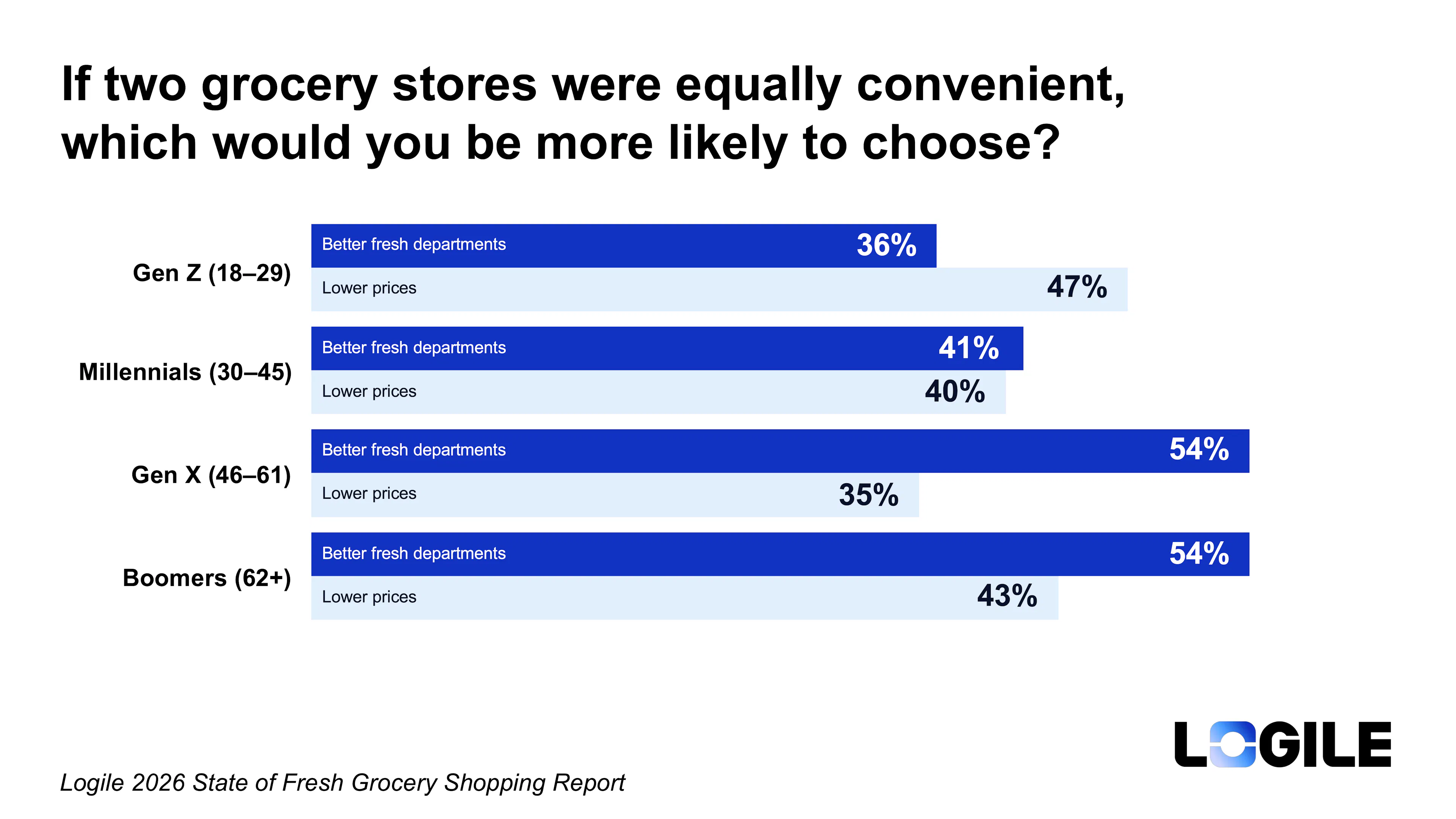
Gen X shoppers (ages 46–61) are the most fresh-devoted generation in the data. 54% would choose a store with better fresh departments over one with lower prices, the highest of any age group. They’re also the most attentive to sensory cues: 74% cite clean displays as a freshness indicator, 72% flag visible damage, and 61% say produce appearance is “extremely significant” in purchasing decisions, again the highest of any generation. And they act on those standards. 75% have switched stores due to dissatisfaction with fresh departments.
Boomers (62+) are similarly sensory-driven – 80% cite fresh smell as a freshness indicator, and 77% emphasize clean displays, both the highest of any generation. And 84% agree that fresh food is a main reason they still shop in person, the strongest in-store pull of any age group.
Gen Z (18–29) tells a different story. They’re the most price-sensitive generation: 47% choose the cheaper store when convenience is equal, compared to just 35% of Gen X. Only 36% of Gen Z pick the store with better fresh departments. But they haven’t tuned out – 75% have still switched stores for better fresh, and 64% agree that fresh keeps them coming to physical stores. Gen Z is also the most label-conscious generation: 65% point to clear labeling and dates as a freshness indicator, the highest of any age group. For grocers, the takeaway is practical: Gen Z responds best when freshness is easy to verify quickly through clear dates, product info, and visible handling standards, which helps fresh compete even when price is top of mind.
Millennials (30–45) bridge the gap. 46% choose fresh over price, right at the overall average, and their sensory and switching patterns fall between Gen X and Gen Z on nearly every metric.
Fresh Food Is Why People Still Walk Into Grocery Stores
In an era when nearly everything can be delivered, fresh food remains the anchor that keeps shoppers coming to physical stores – and prepared foods are extending that advantage.
74% of respondents agree (38% strongly and 36% somewhat) that one of the main reasons they still shop for groceries in person is the fresh food departments. Only 8% disagree with the statement. For nearly three-quarters of American grocery shoppers, fresh is the reason the trip is worth making.
Higher-income shoppers feel this pull most strongly. Among those earning $100K–$149K, 87% agree that fresh is a primary reason for in-store shopping. Among those earning $75K–$99K, the figure is 79%. These are the customers with the most alternatives accessible – delivery services, meal kits, personal shoppers – and they’re still choosing to walk the produce aisle themselves.
Prepared foods are deepening this connection. 68% of shoppers say hot meals like rotisserie chicken, pasta, or other ready-to-eat dinners would encourage them to buy from the deli or prepared foods section. Fresh salads come next at 57%, followed by cold sandwiches or wraps at 56%. Grab-and-go snacks attract 43%. These aren’t niche preferences – two-thirds of all shoppers want hot prepared meals from their grocery store, making the deli a direct competitor to fast food, takeout, and meal kit delivery. And 53% of shoppers buy from fresh departments on most or every trip, with another 22% buying on about half their trips.
But the data also reveals a vulnerability. 20% of shoppers say they often or very often find fresh items they want sold out – a stockout problem that could push even loyal in-store shoppers toward online alternatives. And when asked what would most improve their store’s fresh departments, the top answers are more variety (56%) and fresher produce (51%). Expectations are rising. Shoppers want more from fresh, not less, and they want it consistently.
That consistency, including having the right fresh items available when shoppers want them, is where the operational challenge lives. Unlike packaged goods, fresh items can’t be pulled from a back room when a display runs low. Production takes time, freshness windows are short, and demand fluctuates throughout the day, which makes both freshness and availability harder to sustain. Maintaining abundant, high-quality displays and keeping key items in stock requires coordinating production, labor, and inventory in real time, a level of operational synchronization that most retailers still manage through fragmented systems and static plans.
HMR and prepared foods are a big part of that execution story. A clean, organized, well-stocked deli and HMR set reinforces freshness in the most visible way possible because it is food shoppers expect to be ready now, not later. In the survey, 68% say hot prepared meals would encourage them to buy from the deli or prepared foods section, making HMR a meaningful lever for both trip motivation and fresh department credibility.
Fresh Execution Is Becoming Grocery Retail’s Competitive Advantage
The takeaway is clear: fresh departments have become one of the most powerful drivers of trust, loyalty, and competitive differentiation in grocery retail. Retailers that treat fresh departments as a visible promise keeping them clean, abundant, well-stocked, and easy to shop can create a storewide perception lift that is difficult for competitors and online alternatives to match.
“Fresh is physical retail’s strongest advantage – no digital channel can replicate food that looks, smells, and feels freshly prepared,” said Purna Mishra, Founder and CEO of Logile. “But our data shows that shoppers’ expectations for fresh departments, including freshness and in-stock availability, are rising faster than most retailers can keep up. The grocers who figure out how to consistently execute fresh at scale – synchronizing demand, production, labor, and inventory in real time – are the ones who’ll keep winning trips and building loyalty. The ones who don’t will keep losing customers to the store down the street that gets it right.”
The challenge is that fresh operations are inherently dynamic. Demand fluctuates throughout the day, production windows are short, labor availability changes constantly, and inventory can’t simply be replenished from a back room once a display runs empty. Yet many retailers still manage fresh departments through disconnected systems, manual adjustments, static forecasts, and reactive decision making.
That operational gap is becoming more visible to shoppers.
The retailers winning in fresh are moving toward a more connected operating model – one that synchronizes demand forecasting, production planning, labor execution, inventory visibility, and in-store operations in real time. Instead of reacting to spoilage, stockouts, or inconsistent execution after they happen, they’re building systems that help stores anticipate demand, align production with actual shopper behavior, and maintain freshness standards consistently throughout the day.
Fresh has become one of physical retail’s strongest competitive advantages. But delivering it consistently at scale requires more than good merchandising. It requires operational precision, coordination, and real-time execution across the entire store. That’s increasingly what separates the stores shoppers trust from the ones they leave behind.
Survey Methodology
The Logile 2026 State of Fresh Grocery Shopping Report was conducted in March 2026 in partnership with the third-party survey platform Pollfish. The survey collected responses from 1,000 U.S. consumers ages 18+.
Frequently Asked Questions About the Logile 2026 State of Fresh Grocery Shopping Report
The Logile 2026 State of Fresh Grocery Shopping Report is a consumer survey about how fresh departments affect grocery shopping behavior. Logile worked with Pollfish in March 2026 to survey 1,000 U.S. consumers ages 18+ about fresh food departments, store trust, shopping frequency, prepared foods and in-store grocery habits.
Fresh departments have a strong effect on grocery store trust. 91% of shoppers rated fresh departments as highly influential in deciding whether they trust a grocery store.
Yes. 78% of shoppers have chosen a different grocery store because its fresh departments looked better than their usual store's. That includes 25% who said they do this frequently. Only 5% said they have never switched stores over fresh quality.
A poor produce or fresh section can change how shoppers view the whole store. 84% of shoppers say a poorly maintained produce or fresh section affects their perception of the entire store a great deal or quite a bit. For grocers, this means fresh execution can affect more than one department.
When two grocery stores are equally convenient, 46% of shoppers said they would choose the store with better fresh departments, while 40% said they would choose the store with lower prices. Price still matters, but the data shows that fresh quality can win when location is equal.
Many shoppers still go to stores because they want to evaluate fresh food in person. 74% of consumers agree that fresh food departments are one of the main reasons they still shop for groceries in person.
The top freshness indicators for shoppers are visible and sensory cues: No visible damage, spoilage or discoloration (69%); clean displays, cases or counters (69%); fresh smell from baked goods or prepared foods (64%); and food that looks recently made or prepared (62%).
Poor-looking produce can hurt both item-level sales and broader confidence in the store. 85% of shoppers say the appearance of produce is extremely or somewhat significant in their purchasing decisions.
68% percent of shoppers said hot meals such as rotisserie chicken, pasta or ready-to-eat dinners would encourage them to buy from a store's deli or prepared foods section, followed by fresh salads (57%) and cold sandwiches or wraps (56%).
Shoppers judge stores by how fresh departments look, smell and stay stocked. Retailers need labor, production planning and inventory visibility to keep fresh departments consistent throughout the day. When that breaks down, shoppers notice.
Related Resources
- Solutions: Logile Fresh Operations Management
- Blog: Fresh Perspectives Q&A: How Automation, AI, and Connected Systems Are Shaping Fresh Food Operations
- Blog: Rethinking Scale Management in Fresh Operations: The Shift Happening Inside the Store
- Survey Report: 2025 Logile Convenience Store Food Quality & Safety Report
Recent Posts
What 1,000 Shoppers and 200 Retail Leaders Told Logile About Fresh Operations
2026-10-08
Fresh shapes where shoppers buy groceries and which stores they trust. Two Logile studies reveal a gap between shopper expectations and retailers’ visibility into fresh operations—and where grocers can focus their efforts.
Read More
Holiday Is the Ultimate Test of Your Labor Plan
2026-10-05
Holiday puts every labor planning assumption to the test. See how retailers can model demand, staffing, service, and cost scenarios before stores have to.
Read More
Fresh Operations Industry Survey
2026-10-01
Logile’s survey of 200 retail leaders reveals fresh operations challenges across visibility, shrink, labor planning, AI and technology.
Read More