
Retail rarely goes exactly to plan. Customer demand, promotional performance, fulfillment volumes, labor availability, and other operating conditions can all change over the course of the year, meaning a store that looked properly staffed when the annual plan was approved may be operating under very different circumstances months later.
Effective labor planning accounts for that reality. Rather than trying to predict every change before it happens, retailers need a planning process that can adapt as operating conditions move away from the assumptions behind the original plan.
Why static labor planning fails modern retail
A static plan is not necessarily flawed on the day it is approved. It becomes less useful when its assumptions are no longer current. A sales plan may change, a new fulfillment offer may gain traction, a promotion may pull demand into a different daypart, or a labor market may tighten in selected stores. If the plan does not change with those conditions, the schedule inherits a problem it cannot fully resolve.
The issue is not that retailers need to abandon annual planning. Annual targets create a necessary baseline. The issue is treating that baseline as a finished answer. When planning inputs are held fixed while operating reality moves, local managers are left to bridge the gap with swaps, edits, overtime, and informal workarounds.
- Budgets can become detached from the work stores are expected to complete.
- Labor standards can lag changes in process, assortment, fulfillment, or service expectations.
- Separate spreadsheets can create competing views of demand, required hours, and available labor.
- A store can appear “on plan” in total hours while still missing coverage at the moments that matter.
Why scheduling is not labor planning
Scheduling assigns available people to shifts, tasks, or coverage windows. Labor planning determines the demand assumptions, workload requirements, staffing needs, workforce capacity, and financial guardrails that should shape those assignments. Those are related decisions, but they are not the same decision.
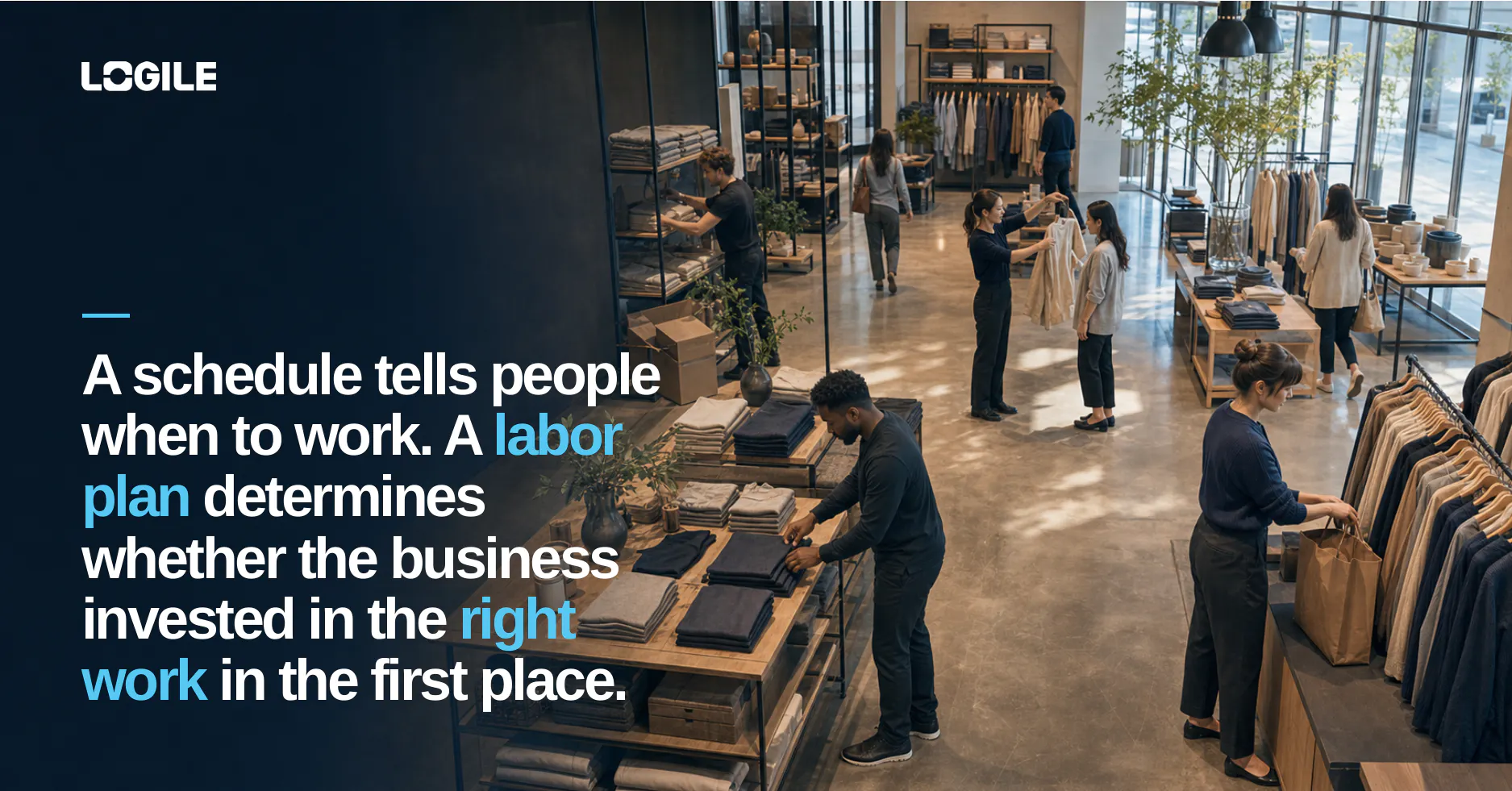
A schedule tells people when to work. A labor plan determines whether the business invested in the right work in the first place.
When a retailer starts with the schedule, the conversation often becomes “Who can we place?” A planning-first approach asks a more useful series of questions: What demand do we expect? What work will it create? How much time should that work take? Where and when does it need to happen? Do we have the roles, skills, availability, and dollars to cover it? Only then is a schedule ready to be built.
Why demand forecasting comes first
Demand forecasting is the opening signal for labor planning. It gives teams a forward-looking view of the conditions that will drive work: sales, transactions, traffic, units, item activity, fulfillment orders, or other operational measures. The most relevant signal can differ by format, department, and task. The key is to use the signals that explain why work changes, not simply a broad total that arrives after the work has already shifted.
A forecast should also be refreshed as new information becomes available. Promotions, holidays, local events, weather, operating-hour changes, and actual performance can all warrant a revised view. Continuous reforecasting does not mean constantly starting over; it means keeping the plan connected to the best available view of demand.
Translating demand into workload
Demand does not create labor hours on its own. It creates work. A rise in transactions can add checkout and service activity. A shift in item mix can alter receiving, stocking, or preparation. A pickup-order increase can add picking, staging, substitution, handoff, and exception handling. A promotion may produce a larger replenishment burden before it produces a visible sales result.
That translation is where a retail labor plan becomes operational. Instead of asking for one number of hours for an entire store, teams can identify the work by store, department, task grouping, and interval. This makes competing needs visible. It also makes it possible to explain why an hour is needed, rather than debating an unexplained allocation.
Connecting workload to labor standards
Labor standards create a disciplined connection between work content and labor requirements. They help teams define the expected time, frequency, sequence, and conditions for work. Good standards are not meant to flatten every store into the same operating model. They create a common foundation while allowing planners to account for format, department, process, and store-specific differences.
This is especially important when work is not directly visible in a sales number. Tasks such as replenishment, order staging, opening procedures, compliance checks, and recovery still require time. If those tasks are absent from the model, the schedule may look efficient on paper while the store absorbs the work through missed tasks, service tradeoffs, or manager intervention.
Understanding workforce capacity
Required labor is only one side of the plan. Capacity is the other. A retailer may have enough headcount in total but lack enough availability at peak intervals, enough trained people in a department, or enough hiring runway in a particular market. Capacity also changes as associates join, leave, change availability, or gain skills.
A useful capacity view considers headcount, role and skill mix, availability, productive hours, planned absences, attrition, hiring progress, and cross-training. Comparing that view with workload-driven requirements gives teams an early, practical answer to a critical question: can the plan be executed, and if not, what choice should be made before stores are asked to absorb the gap?
Aligning labor and budget
Operations and finance do not need competing versions of the truth. Operations needs a clear view of what stores must do; finance needs a clear view of what the business can invest. A connected labor plan makes the tradeoff explicit by grounding labor dollars in demand, workload, staffing requirements, and rate assumptions.
This creates a more productive planning conversation. Teams can compare a top-down target with bottom-up requirements, identify the source of a gap, and make an intentional decision. They may adjust a service rule, sequence work differently, revisit a demand assumption, change hiring timing, or approve additional investment. What matters is that the choice is visible and made before it becomes an emergency at store level.
Testing scenarios before execution
Retail planning involves uncertainty, not a single perfect forecast. Scenario planning lets teams examine what changes if demand is higher or lower, a promotion performs differently, wage rates move, operating hours change, or hiring is delayed. It also helps reveal which assumptions have the largest impact on labor requirements and budget.
The value is preparation, not prediction theater. By comparing realistic scenarios before a decision is committed, planners can identify guardrails and response options. Stores gain a more stable starting point, and leaders gain time to make tradeoffs while there is still room to act.
Moving from annual planning to continuous optimization
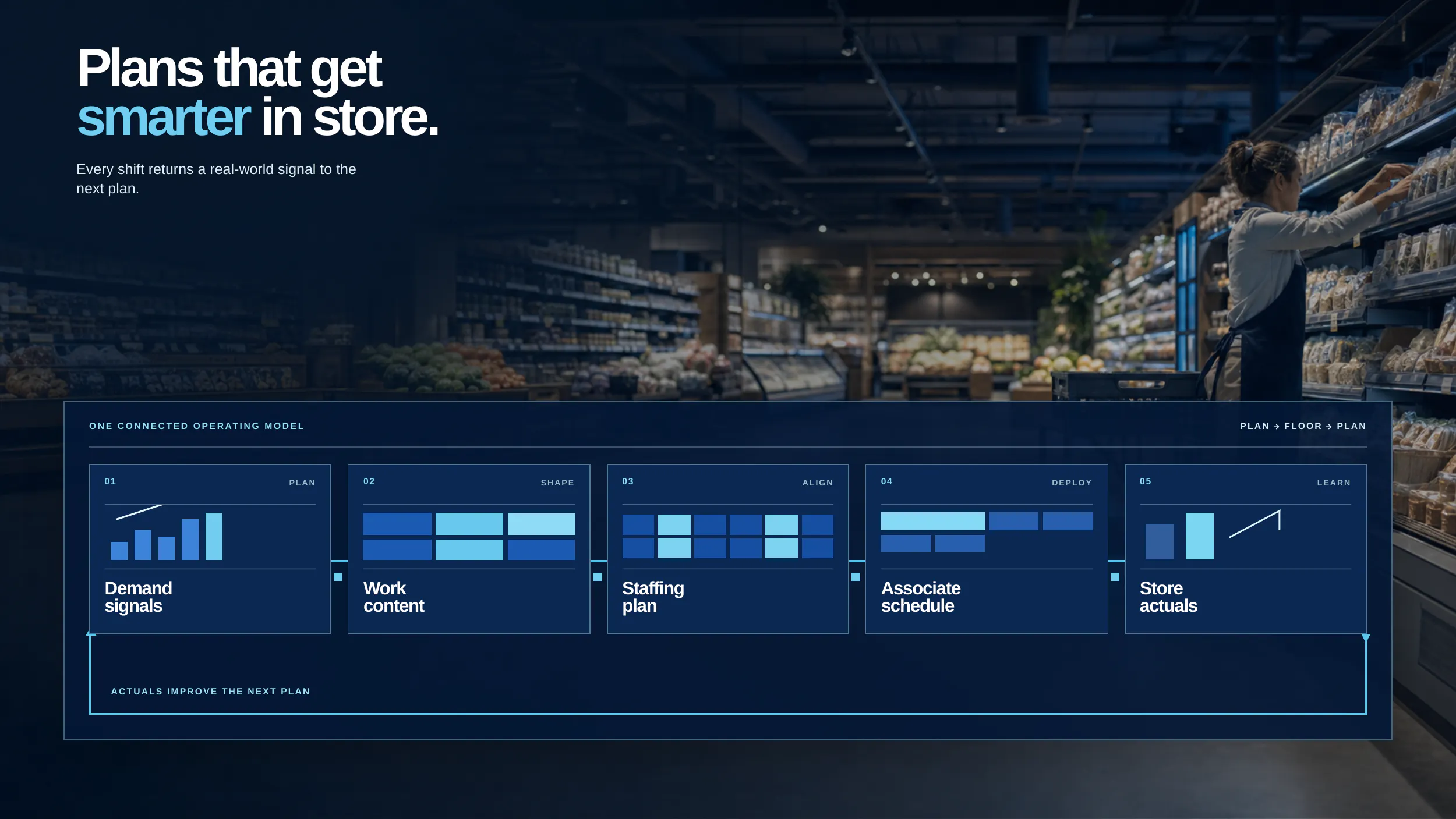
The strongest planning process is a loop: forecast demand, translate it into work, apply labor standards, define staffing requirements, compare them with capacity and budget, build the schedule, and learn from execution. Actual workload, worked hours, service signals, and schedule changes should inform the next planning cycle.
That does not require every decision to be reopened every day. It requires a cadence for reviewing meaningful variance and refreshing the inputs that drive it. The result is a labor plan that becomes more useful as the year progresses rather than less relevant with every new operating change.
Build a Labor Plan Your Stores Can Execute
Start with a simple diagnostic: Can your teams trace today’s schedule back to current demand, defined workload, labor standards, workforce capacity, and a shared budget view? If the answer is unclear, the opportunity is not merely to build schedules faster. It is to build a labor plan that gives stores a better chance to execute with confidence.
Frequently Asked Questions About Continuous Labor Planning
Static labor plans become less accurate when the assumptions behind them no longer reflect current operating conditions. Changes in customer demand, promotions, fulfillment volume, labor availability, wage rates, operating hours, processes, or service expectations can all affect the amount and timing of work. Reviewing meaningful variance and refreshing those inputs helps retailers keep labor plans aligned with what stores actually need.
Common warning signs can include frequent schedule edits, recurring overtime, departments borrowing labor from one another, managers stepping in to cover frontline work, or stores meeting total labor-hour targets while still struggling with coverage at important times. These signals do not necessarily mean the original labor plan was wrong, but they can indicate that operating conditions have moved beyond its assumptions.
Retailers should look beyond worked hours alone and compare actual demand, workload, labor standards, staffing capacity, availability, service performance, schedule changes, and budget assumptions. Understanding which input created the variance helps teams decide whether to adjust staffing, update a labor standard, revise the forecast, change how work is performed, or reconsider the labor investment.
Annual planning can remain the financial and operational baseline while retailers establish a regular cadence for reviewing meaningful changes in demand, workload, workforce capacity, labor costs, and actual store performance. Those insights can then inform updated forecasts and labor requirements throughout the year rather than leaving stores to operate against assumptions established during the annual planning cycle.
Actual workload, worked hours, service levels, schedule changes, overtime, and other execution data can show where planning assumptions differed from store reality. Feeding those insights back into forecasting, labor standards, staffing requirements, capacity planning, and budgeting creates a continuous improvement loop in which each planning cycle benefits from what happened during execution.
Put Your Labor Plan to the Test
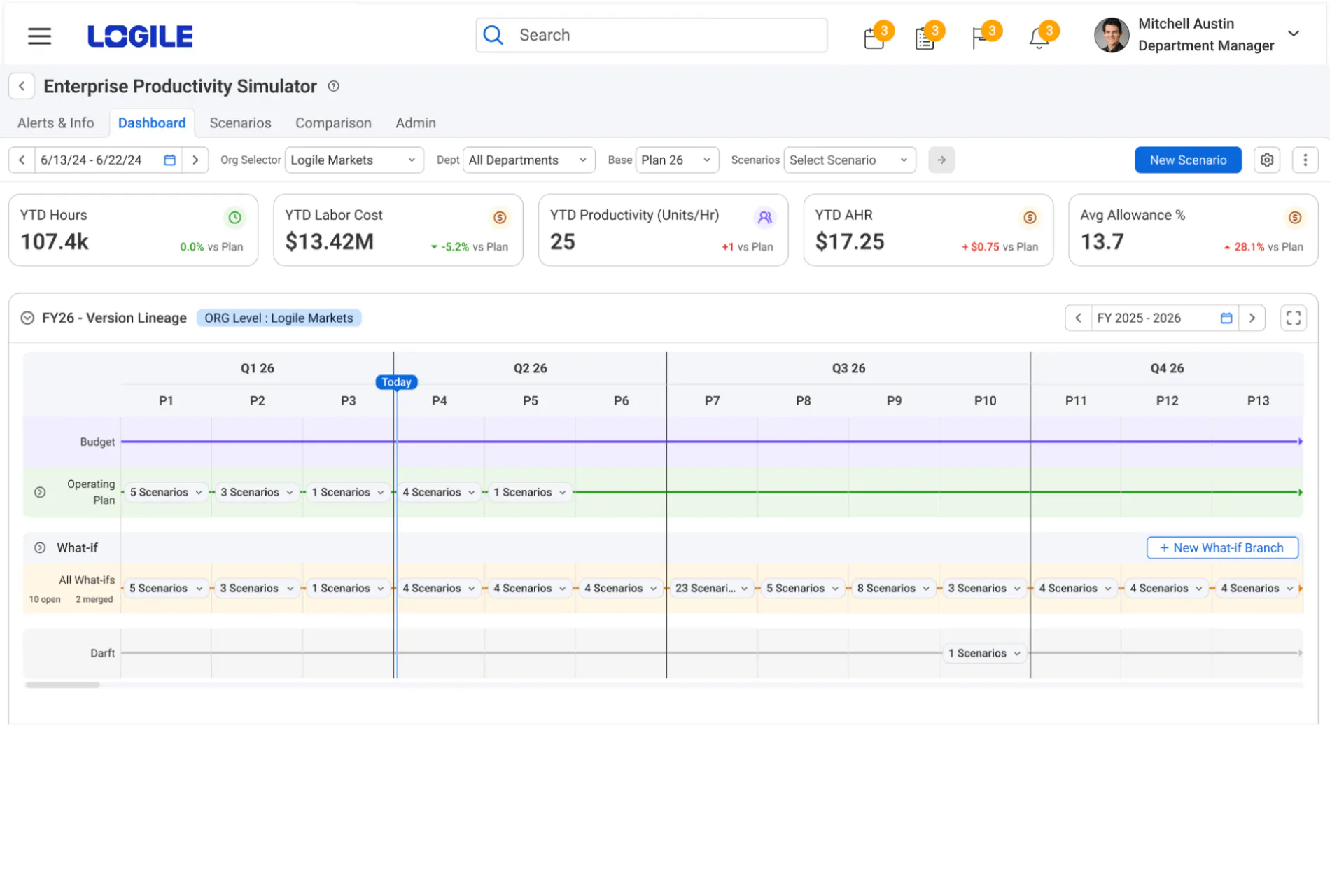
A stronger labor plan doesn’t stop at a single set of assumptions. Logile’s Enterprise Productivity Simulator helps retailers model workforce and operational changes, compare cost, service and productivity tradeoffs, and continuously evaluate plans as conditions change, before those decisions reach the store floor.
Recent Posts
Back-to-School Is Ending: The Q4 Retail Rush Is Already Here
2026-09-01
Back-to-school is ending, but Q4 retail demand is already building. Learn how retailers can prepare labor plans for holiday traffic, promotions and fulfillment.
Read More
The Rise of Workforce Simulation: Why Retailers No Longer Have to Choose Between Enterprise Planning and Store-Level Reality
2026-07-24
Read More